

Fast Facts | Accord Hybrid vs. Camry Hybrid
⚡ Power: The Accord Hybrid produces 204 horsepower, while the Camry makes 225 horsepower with FWD or 232 horsepower with AWD
🌧️ Drivetrain: Every Accord is front-wheel drive, while every Camry trim is available with FWD or AWD
⛽ Best Fuel Economy: The most efficient Accord Hybrid reaches an EPA-estimated 48 mpg combined, while the Camry LE reaches 51 mpg combined
🖥️ Infotainment: Every Accord Hybrid gets a 12.3-inch touchscreen, while the Camry starts with an 8-inch screen and offers a 12.3-inch unit on higher trims
🦵 Rear Seat: The Accord provides more rear legroom, making it the stronger option for shoppers who regularly carry adults or taller teenagers
💰 Starting Price: The Camry starts at $29,300 MSRP before destination, while the Accord Sport Hybrid starts at $33,795 MSRP before destination
🛡️ Safety: The 2026 Camry earns an IIHS Top Safety Pick+ award, while the 2026 Accord earns Top Safety Pick
🎯 Best Fit: The Accord favors refinement and driving feel, while the Camry counters with lower pricing, slightly better maximum MPG, and available AWD
Toyota and Honda go head-to-head in just about every mainstream segment, and their midsize sedans - the Camry and the Accord - have been duking it out for decades. Sedans aren't as popular in the U.S. market as they once were, but they're still an excellent alternative to a compact SUV. Both of these cars offer more rear legroom than the crossovers right above them in their respective lineups.
The Camry is now hybrid-only as of the 2025 model year, and while the Accord still offers a gas-only option, we're focusing on the hybrid here. We've reviewed both the Accord Hybrid and Camry individually, but here we'll put them side by side.
Exterior Design and Dimensions
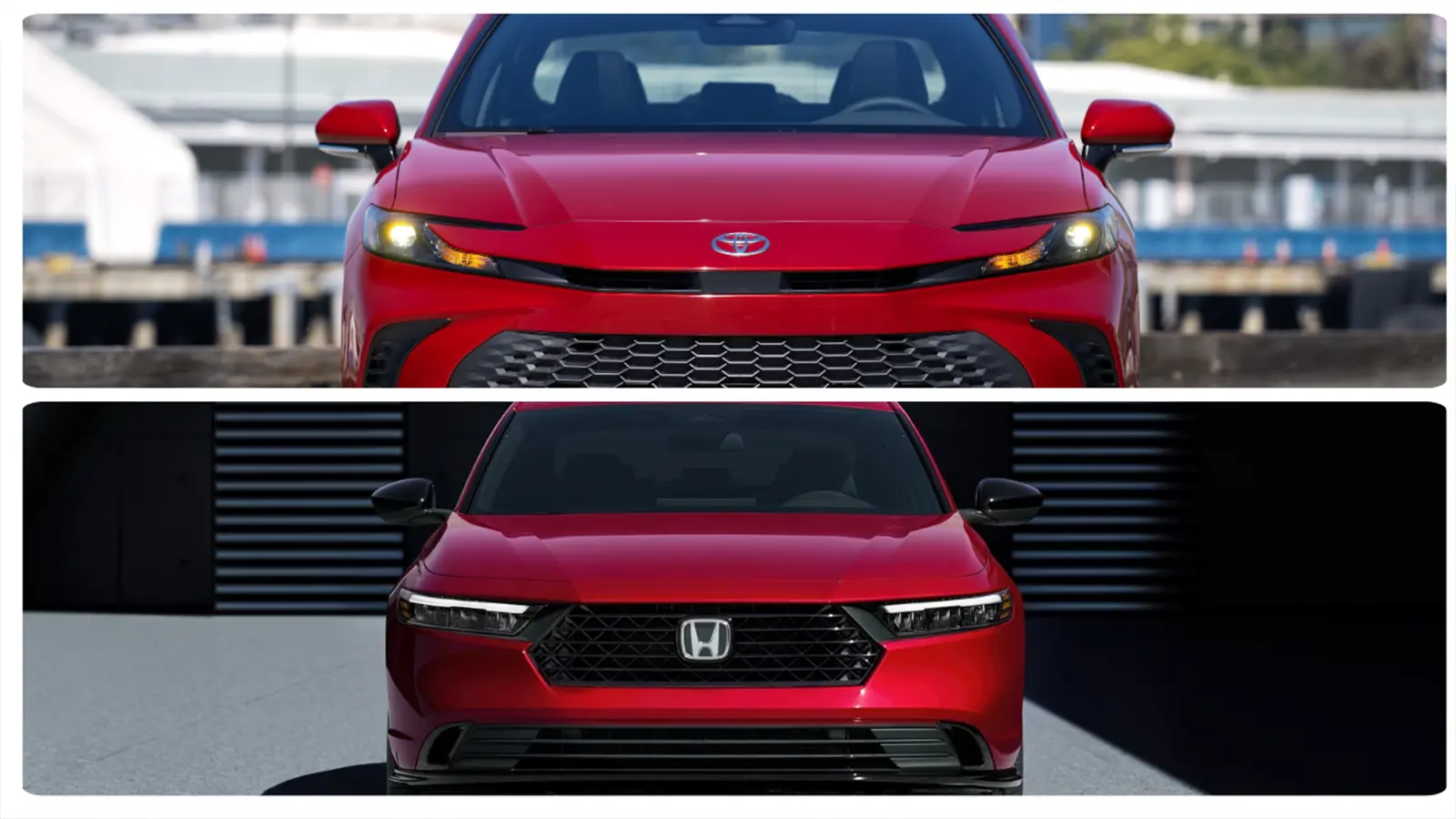
Next to each other, these two couldn’t look more different. The Accord has a clean, sleek design, with a small grille and simple LED headlights up front. The side profile follows suit, with minimal sculpting lines and a fastback-like profile.
The Camry goes in the opposite direction, with more typical three-box sedan styling. Toyota’s signature “hammerhead” lighting anchors the front, flanked by prominent hood lines and a large grille. The aggressive styling continues with sharp sculpting lines down the sides.
Interior Space and Tech
On the spec sheet, the Honda edges out the Toyota across most interior measurements, but the differences are pretty small. The most notable gap is in rear legroom, where the Accord offers 2 more inches than the Camry. If you regularly have long-legged adults or teenagers back there, they may appreciate the difference.

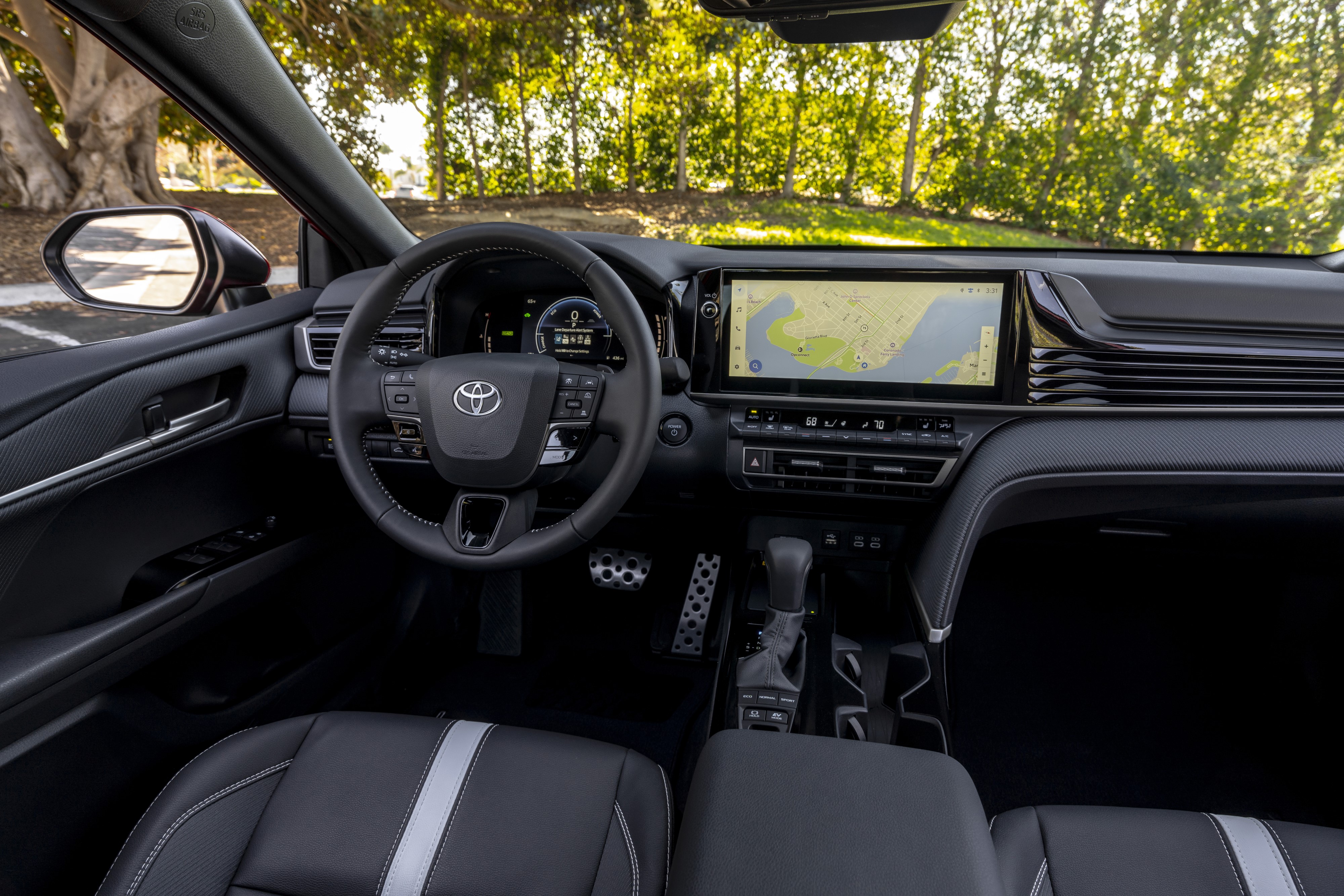
All Accords come standard with a 12.3-inch infotainment screen. The Camry starts with an 8.0-inch screen and steps up to a 12.3-inch touchscreen on higher trims. Both support wireless Apple CarPlay and Android Auto, but the Accord also adds Alexa integration and available Google built-in.
Both Honda and Toyota have a stellar reputation for safety, and these two sedans get plenty of safety tech. Both come standard with adaptive cruise control, lane-departure alert with steering assist, automatic high-beam headlights, road-sign assist, a backup camera, and lane-trace assist.
The Accord and Camry use fundamentally different approaches to blending gasoline and electric power, and our How Hybrid Cars Work guide explains series, parallel, and series-parallel systems in plain English ➜
A few differences are worth calling out. The Accord includes traffic-jam assist as a standard feature, but on the Camry, that's an upcharge, and a panoramic-view monitor is available on the Camry, but not offered on the Accord at all.
When IIHS puts both through their annual safety testing, both have consistently made the Top Safety Pick list for at least the past decade. But the Camry comes out slightly ahead with a Top Safety Pick+ designation.
Powertrain and Fuel Economy
The Honda Accord Hybrid is powered by a 2.0-liter four-cylinder engine paired with two electric motors, delivering a combined 204 horsepower. The Accord Hybrid is only offered in front-wheel drive; all-wheel drive is offered only in the gas-powered Accord.
The Toyota Camry, now exclusively offered as a hybrid, uses a 2.5-liter four-cylinder. Front-wheel drive models produce 225 combined horsepower, and all-wheel drive models get a third electric motor that powers only the back wheels, bumping the combined power output to 232 horsepower.
Toyota and Honda take two completely different approaches to their hybrid systems, so the driving experience is not one and the same. The Camry uses electric power some of the time and relies more heavily on engine power for most of your driving habits. The Accord, on the other hand, relies mostly on electric power, only tapping the engine to charge the hybrid battery or for highway driving speeds.
For fuel economy, the trim level you choose will impact how often you’ll fuel up. At their most efficient, the base model FWD Camry wins by a hair with an EPA-estimated 52/49/51 mpg city/highway/combined. The standard Accord’s highway driving numbers bring it down a bit, with an EPA-estimated 51/44/48 mpg. Base AWD Camrys see an EPA-estimated 50/49/40 mpg.
Price
The Accord has a $1,195 destination charge and the Camry a $1,295 charge added to their MSRPs. The Camry starts at more than $4,000 cheaper: $30,595 MSRP vs. $34,990 MSRP for a base Accord Hybrid. At the top of the lineup, the Camry comes in at $36,995 MSRP, while the top-tier Accord Hybrid will cost you $40,690 MSRP.
Behind the Wheel
When perusing the spec sheets of the Accord and Camry, there’s not a lot to differentiate them. They’re pretty similar in size, and the two-motor hybrid systems seem to produce similar outputs and power-to-weight ratios. But the overall feel of these two drivetrains is fundamentally different.
Each has one motor-generator unit (MGU) that provides the main propulsion effort, while the second is mainly driven by the engine to charge the battery. But the Toyota system only has 134-horsepower from its primary MGU and relies a lot more on the engine blending in its output through an e-CVT gearset. When accelerating, the Camry’s engine revs up to about 4,000 rpm and sits there, making noise until the vehicle speed catches up.
The Accord delivers 181-horsepower from its primary MGU, and the engine remains isolated from the wheels most of the time. The Honda feels much more like driving an EV, only sending some power to the wheels at higher speeds, where you don’t really hear it.
The Camry has a slight edge in rated fuel efficiency, but the real-world difference in fuel consumption is pretty negligible. Apart from the noise, Toyotas have become much more fun to drive in the last decade, but the Honda still has an edge in driving dynamics, as well, especially when it comes to steering feel; ride quality is pretty similar.
Analyst's Perspective (Which One's Right for You)
From a purely functional perspective, the biggest difference between these two sedans comes down to powertrain refinement and winter traction.
The Accord is significantly quieter when accelerating, but if you feel like you need the extra grip of all-wheel drive for snow and ice, the Camry is the only one that provides that choice. However, if you really prefer the looks and refinement of the Accord, a good set of winter tires will get you pretty close to what a car with all-wheel drive and all-season tires offers.
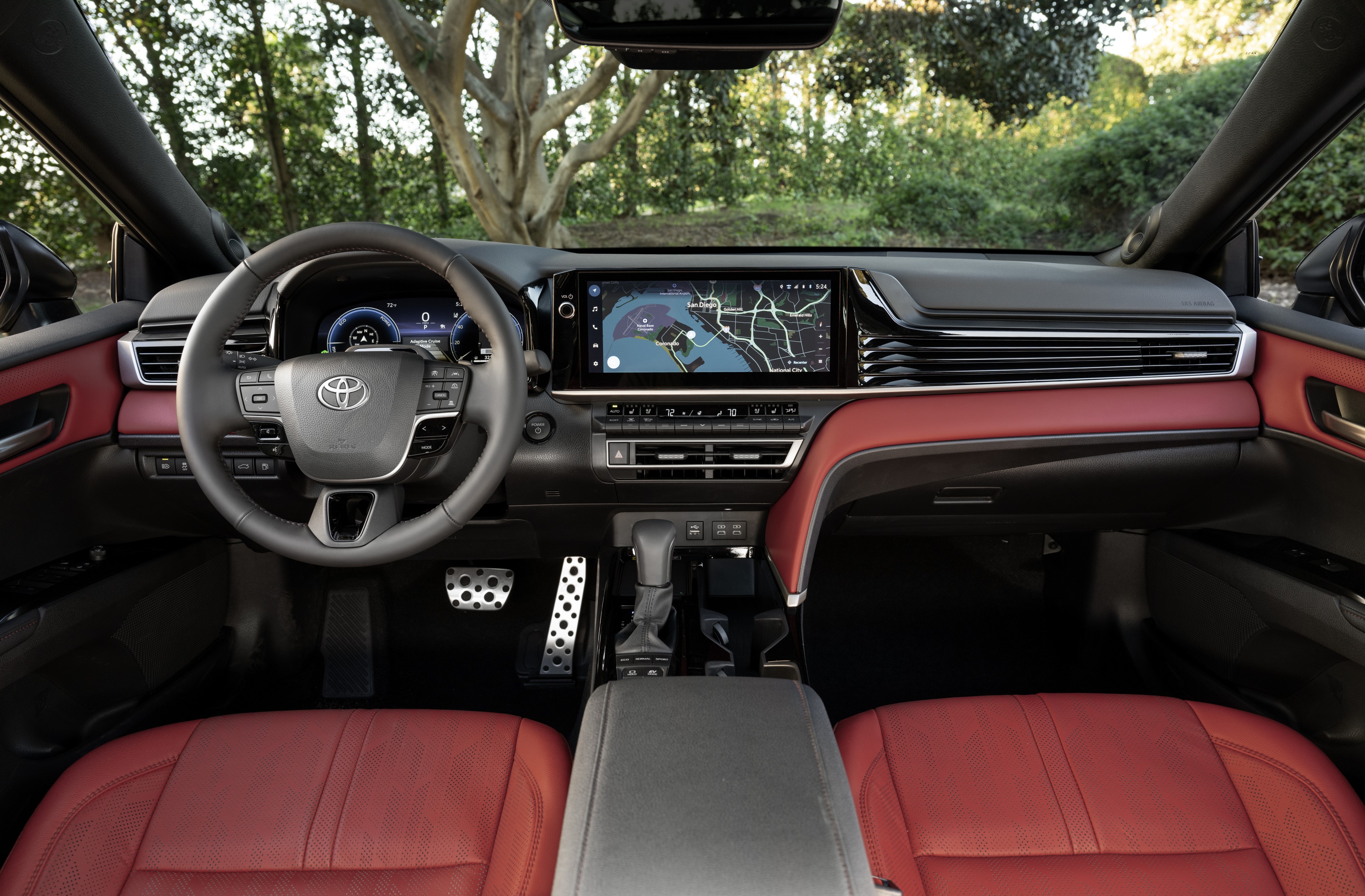
If you’re looking for a bolder design, both inside and out, the Camry definitely has more to offer, with available two-tone paint options including a contrasting black roof, and even a red cockpit interior option. The current Accord is much more restrained, but both cars have good overall ergonomics. My personal preference would be the Accord, but you won’t go wrong with either choice.
Take a Closer Look at Both Hybrid Sedans
The Honda Accord Hybrid Deserves Your Attention
Take a deeper look at the Accord Hybrid’s EV-like power delivery, spacious interior, excellent fuel economy, and polished driving experience.
2026 Toyota Camry All-Wheel Drive Review
See how the Camry Hybrid’s available AWD performs in winter conditions and whether it gives the Toyota a meaningful advantage over front-drive rivals.
Shop Hybrid Vehicles Nationwide
Browse real hybrid sedans, crossovers, SUVs, and fuel-efficient vehicles for sale through the GreenCars Marketplace.