


 Announcements
Inside GM's Plan for Its Next-Gen EVs
At its second annual GM Forward event in New York City, GM shared new details on OnStar AI, fourth-gen EVs, and the eyes-off highway driving system it's targeting for 2028.
Sam Abuelsamid7 min read

GM plans to introduce eyes-off highway driving on the Cadillac Escalade IQ in 2028. Mandi Damman explains why letting drivers look away requires vehicle-mounted lidar, overlapping sensors, redundant controls, more powerful computing, and a far deeper approach to testing.
General Motors plans to bring eyes-off driving to the Cadillac Escalade IQ in 2028, beginning on highways. The capability is not available to consumers today, and where it can be used will depend partly on state law.
GM describes the system as one that will perform the driving task within an approved set of conditions without depending on the driver to watch the road continuously. That is a meaningful step beyond today’s Super Cruise, which can steer, accelerate, brake, and change lanes while the person behind the wheel remains responsible for monitoring traffic.
Damman says she joined GM at 18 as a Kettering University co-op student working on body structures. She later moved through roles involving vibration, noise, vehicle dynamics, the original Chevrolet Bolt, Cadillac EVs, electric trucks, and Super Cruise. She is now GM’s executive chief engineer for autonomous and electric vehicles, leading work that includes the Chevrolet Bolt and the integration of autonomous technology into future GM programs.
Damman’s career is a reminder that autonomy still has to survive potholes, failed components, electrical faults, and everything else the physical vehicle encounters. The computer may decide where the Escalade IQ should go, but the physical vehicle still has to steer, brake, maintain power, understand its surroundings, and remain controlled when something goes wrong.
Today’s Super Cruise is a hands-free, eyes-on driver-assistance system. The driver can remove their hands from the steering wheel on compatible roads, but a camera continues watching their attention. They must remain ready to respond when the system requests help.
Eyes-off operation shifts more responsibility to the vehicle. If the driver is reading a message or looking elsewhere, the system cannot treat an attentive human as its immediate response to road debris, sudden construction, a failed sensor, or another unexpected event.
Damman said this is where GM’s Super Cruise and Cruise robotaxi work are beginning to come together. GM is not simply moving Cruise software into a customer-owned vehicle. It is carrying over engineers, safety practices, validation experience, and lessons from designing vehicles that could not rely on continuous human supervision.
There is still an important distinction. The Escalade IQ is not being presented as an unrestricted robotaxi that can drive anywhere without an available human. It will operate within what engineers call an operational design domain, meaning a defined set of roads, speeds, weather conditions, traffic situations, and other circumstances in which the feature is permitted to work.
The gap between hands-free assistance, conditional automation, and unrestricted robotaxis is easy to blur, so see where Level 2, Level 3, and driverless technology stand in 2026 ➜
GM has not publicly detailed every takeover rule for the production system. Until it does, eyes-off should not be interpreted as permission to sleep, leave the driver’s seat, or assume the vehicle can complete every trip without assistance.
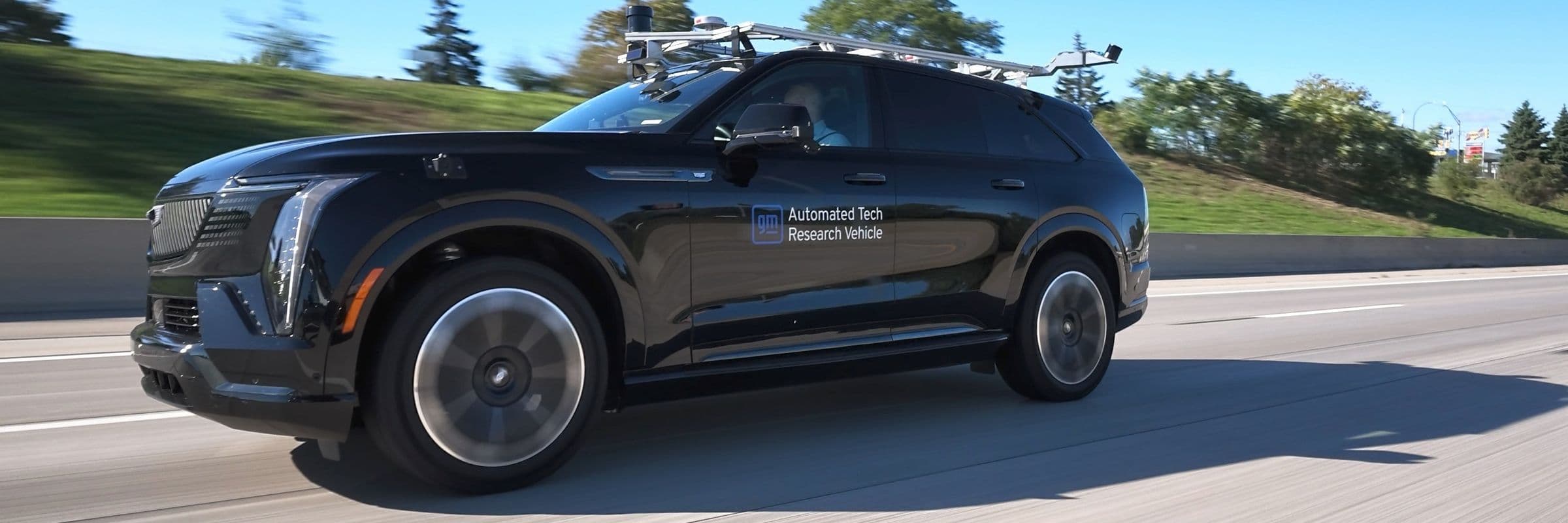
Simulated image of a 2028 Cadillac Escalade IQ by GM. Production vehicle may vary.
The 2028 system will add vehicle-mounted lidar and expand GM’s camera, radar, and computing capabilities. Current Super Cruise uses maps created with lidar, but it does not have an onboard lidar sensor watching the road in real time.
Cameras are useful for reading lane markings, signs, and other visual details. Radar is well suited to tracking distance and speed. Lidar sends light pulses into the environment and measures their return, creating a three-dimensional view of nearby roads, vehicles, and objects.
Lidar alone does not make an automated vehicle safe. GM’s strategy is based on sensor fusion, allowing the system to compare what its cameras, radar, and lidar are reporting before deciding how to respond. The safety case becomes especially important when those sensors disagree or one of them cannot provide a reliable view.
Sensor overlap is only part of the plan. Damman said the production system will also need backup paths for steering, braking, computing, sensing, and 12-volt electrical power. Those systems matter because the vehicle cannot assume the driver will immediately notice a steering fault, loss of braking assistance, failed sensor, or interruption in low-voltage power.
The eyes-off system will run on GM’s new centralized computing architecture, scheduled to debut with the Escalade IQ in 2028. Instead of distributing intelligence across many separate modules, the platform will connect propulsion, steering, braking, infotainment, and safety through a shared high-speed computing core.
GM says the architecture will provide up to 35 times more AI performance, 1,000 times more bandwidth, and 10 times more capacity for over-the-air software updates than its previous systems. The company plans to use the same core platform in both electric and gasoline-powered vehicles.
Because eyes-off driving depends on additional sensors, centralized computing, and safety-critical backup hardware, existing Super Cruise vehicles should not be expected to gain the full capability through software alone.
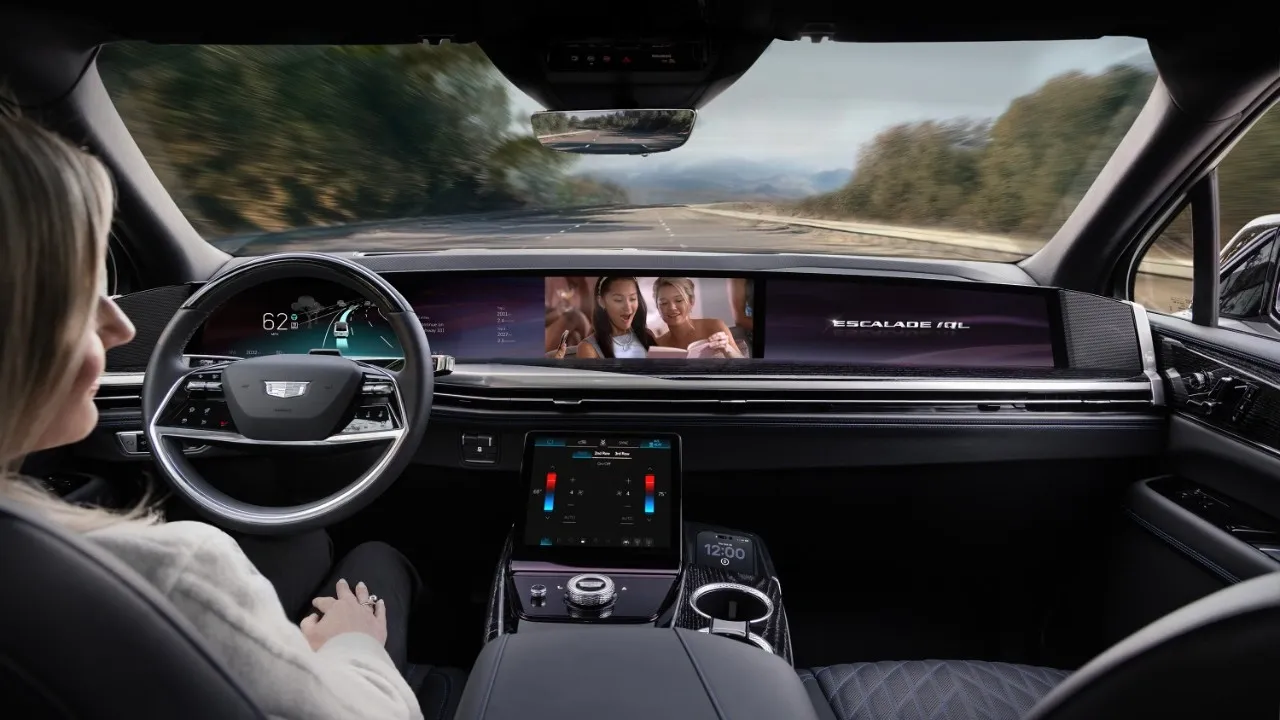
2028 Cadillac Escalade IQL. Simulated image by GM. Production vehicle may vary.
The hardest scenario is not the one the system handles correctly. It is the failure that appears while the driver is looking somewhere else.
GM says more than 200 manual and supervised development vehicles will gradually enter live traffic. Supervised testing began on limited-access highways in California and Michigan in March 2026, with trained test drivers ready to take control. The company’s data-collection vehicles had already covered more than one million miles across 34 states before that phase began.
GM is not the only automaker using real-world information to improve driver-assistance systems, see how Volkswagen plans to turn customer-vehicle data into safer ADAS behavior ➜
Public-road driving is only one layer of the development process. Damman said GM is also using more than 100 hardware-in-the-loop benches, where real vehicle modules, wiring, and computers can be connected and tested before a complete production prototype exists.
Engineers can load new software, inspect communication between components, simulate failures, and run repeated tests overnight. GM has also assembled a frame at its Milford Proving Ground containing the modules and wiring intended for the vehicle, allowing the team to test the electrical system before the final vehicle build.
No single test environment can prove the whole system. Road testing exposes the system to natural traffic behavior. Laboratory benches isolate hardware and communication problems in a controlled setting. Simulation lets engineers repeat rare or dangerous events at a scale that would be impossible to reproduce through public-road miles alone.
GM says its simulation environment can model the equivalent of roughly 100 years of human driving every day. That work is supplemented by more than five million fully driverless Cruise miles and the billion customer-driven Super Cruise miles already completed across North America.
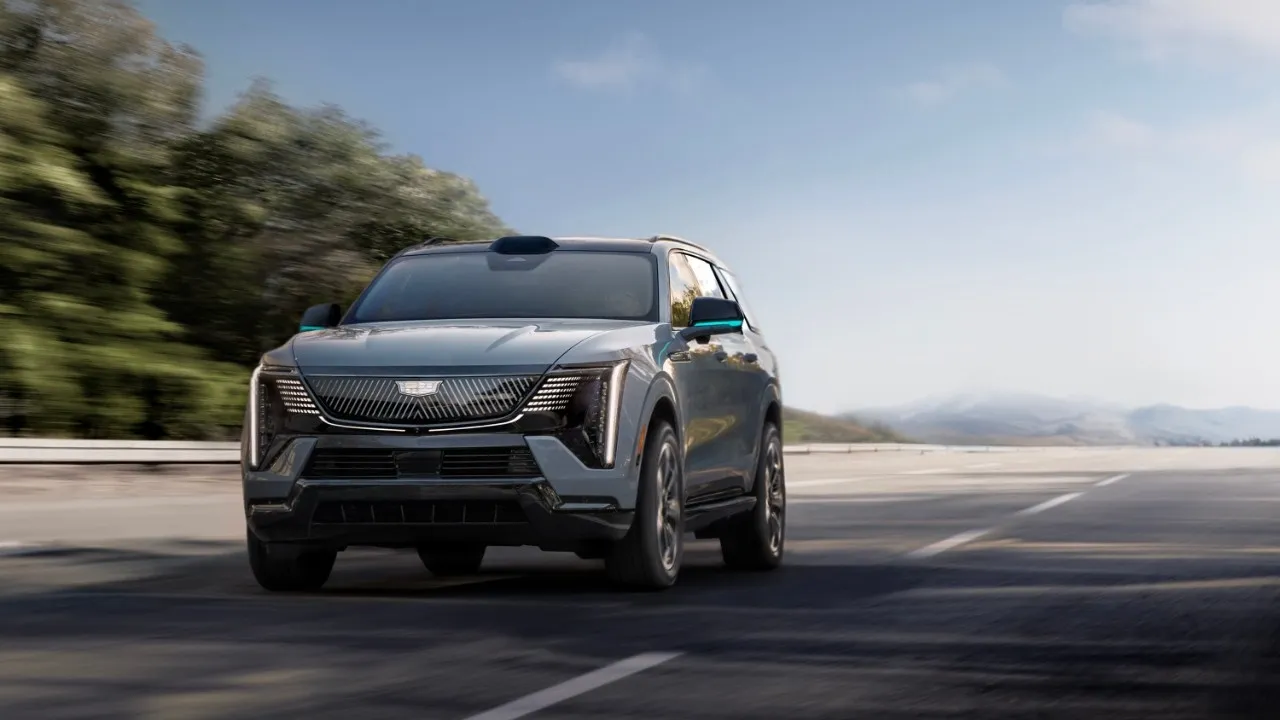
Simulated 2028 Cadillac Escalade IQ by GM. Production vehicle may vary.
Highways offer a more structured environment than city streets. They generally have fewer pedestrians, intersections, traffic lights, and vehicles crossing directly through the car’s path. That makes them a more manageable place to introduce a system that does not require continuous driver attention.
Highway-first does not mean highway-unlimited. The feature will still operate only on approved roads and within defined conditions involving location, traffic, weather, visibility, and vehicle status.
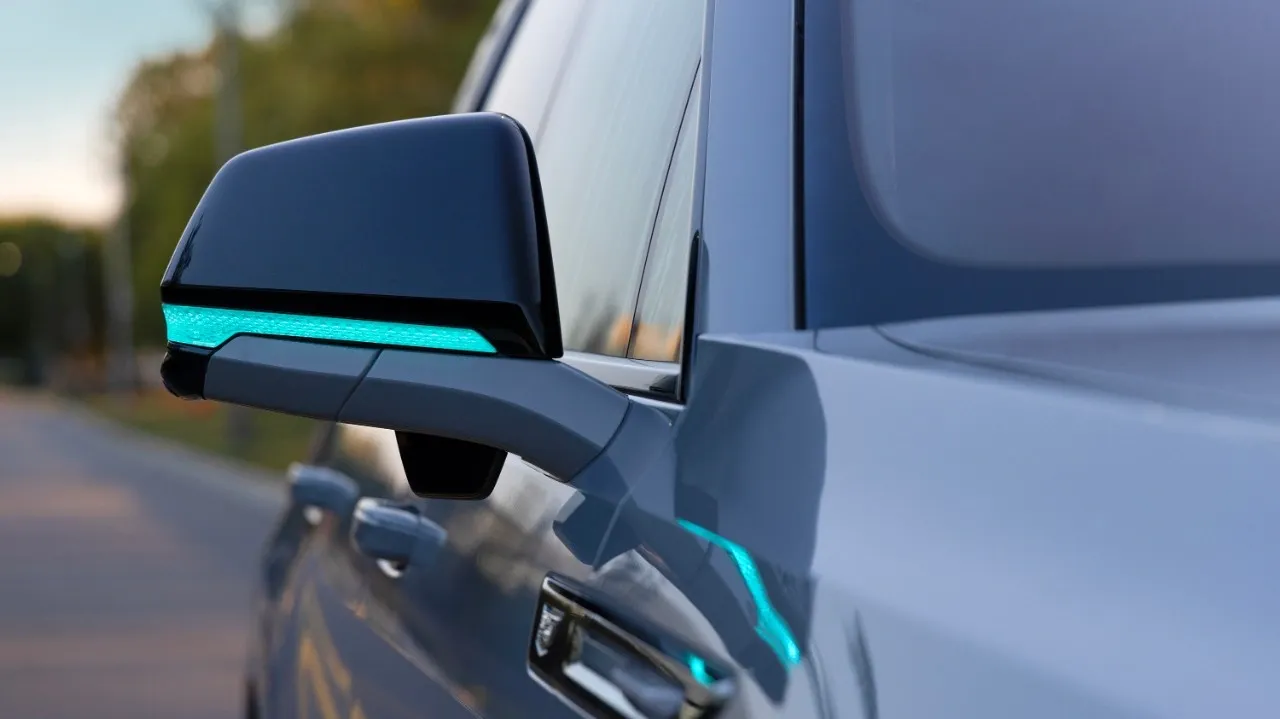
GM says turquoise lighting across the dashboard and exterior mirrors will indicate when eyes-off operation is active. The visual signal is intended to make the system’s status clear before the driver turns their attention away from traffic.
Over time, GM wants to expand from highway use toward driveway-to-driveway operation. Damman also said the technology is intended to move beyond Cadillac into higher-volume SUVs, smaller crossovers, and pickups as the system is validated and its hardware becomes easier to scale.
The Escalade IQ provides room to introduce expensive sensors and computing in a premium vehicle before GM attempts to spread the technology across mainstream models. Super Cruise followed a similar path, moving from Cadillac into Chevrolet, GMC, and Buick products at a range of prices.
GM can validate the hardware in a laboratory and build millions of miles of driving data. It still has to earn the driver’s willingness to look away.
Damman described that hesitation from her own development rides. Even when the vehicle was operating comfortably, the instinct was to keep watching until repeated experience built confidence.
Looking away may be the feature. Knowing when it is safe to do so will be the product.
Driving the 2025 Cadillac Escalade IQ: Cadillac’s Biggest, Boldest EV Yet
Meet the electric flagship that GM selected to introduce its new computing architecture and eyes-off system in 2028.
Read More ➜
The GreenCars Podcast Is Back With New Conversations About the Future of Driving
The second season features longer conversations with the engineers and executives shaping electrification and autonomy, including Mandi Damman.
Read More ➜
Car Safety Tech of the Future
A broader look at how cameras, radar, lidar, artificial intelligence, and connected systems are expanding the modern vehicle-safety toolkit.
Read More ➜
Get vehicle reviews, practical tips, and the latest GreenCars news.
AnnouncementsAt its second annual GM Forward event in New York City, GM shared new details on OnStar AI, fourth-gen EVs, and the eyes-off highway driving system it's targeting for 2028.
 Industry Updates
We've made a lot of progress, but your car still can't drive you to work while you catch up on sleep - and it probably won't be able to anytime soon.
 Industry Updates
As part of its new UEV program, Ford is integrating Apple Maps into its vehicles for navigation, charger routing, and next-gen BlueCruise.