- AI Usage
- Cars.com reported that 44 percent of consumers in one 2025 survey used AI-powered car search tools
- Research Role
- Cox Automotive found AI users are most likely to use it for researching vehicles, price ranges, what they should pay, and monthly payments
- Best Use Case
- AI can help organize EV, hybrid, and plug-in hybrid shopping needs before shoppers get serious
- Charging Reality
- Home charging, apartment parking, workplace charging, and public charging can lead to very different recommendations
- Range Check
- EV range can vary based on weather, highway speed, terrain, climate control use, and driving style
- Prompt Quality
- Better AI recommendations come from better inputs, including budget, driving habits, cargo needs, climate, and must-have features
- Red Flags
- Shoppers should ask AI what assumptions it made and what downsides each recommendation has
- Best Workflow
- Use AI to brainstorm, then use GreenCars Matchmaker and Buyer’s Guide to compare real options
Car shopping used to mean juggling 20 browser tabs, conflicting reviews, spec sheets, payment calculators, dealer listings, and maybe one overly confident uncle who still thinks every hybrid drives like a golf cart.
Now, shoppers have a new tool in the garage: artificial intelligence.
While AI should not choose your next car, it can help you ask better questions before you shop. For EV and hybrid shoppers, that means organizing your budget, charging access, driving habits, cargo needs, and priorities into a more useful vehicle shortlist.
AI is quickly becoming part of the car-shopping journey. Cars.com reported that 44 percent of consumers in one 2025 survey used AI-powered car search tools, while Cox Automotive found that shoppers who have tried AI tools are most likely to use them for researching vehicles, determining price ranges, estimating what they should pay, and calculating monthly payments.
That does not mean AI should choose your next car for you. Please do not let a chatbot become your financial advisor, mechanic, dealer, and life coach all in one sitting. That is how you end up with a seven-passenger SUV recommendation when you asked for something easy to park.
But AI can be genuinely useful. Especially if you are shopping for an electric car, hybrid, or plug-in hybrid, where the decision can involve more than just price, size, and color. Charging access, driving range, commute length, road trips, fuel savings, climate, cargo space, and daily lifestyle all matter.
Used correctly, AI can help you ask better questions before you start shopping seriously.
Why AI Can Help with Green Car Shopping
Electric and hybrid vehicles come with a few extra variables. A traditional gas car shopper might ask: Can I afford it, does it fit my life, and do I like driving it?
A green car shopper often has to add a few more questions:
· Can I charge at home?
· How far do I actually drive each week?
· Do I need long highway range?
· Would a hybrid fit my lifestyle better than a full EV?
· Would a plug-in hybrid give me the best of both worlds?
· How much cargo space do I need?
· Will cold weather affect my range?
· Is the lowest sticker price actually the best long-term deal?
That is where AI can be helpful. It can turn your messy list of needs into a more organized shortlist. It can compare EVs, hybrids, and plug-in hybrids in plain English. It can help you think through total cost of ownership, not just monthly payment. It can also help you generate follow-up questions before visiting a dealership or comparing models.
The key is giving AI better information up front.
Garbage in, garbage out still applies. It just wears a nicer interface now.
Before You Use AI to Shop for a Car
Before you paste a prompt into ChatGPT, Gemini, Copilot, Claude, Perplexity, or another AI tool, spend five minutes getting honest about your real life.
Know your rough budget. That should include your purchase price range or monthly payment comfort zone.
Be realistic about charging. Home charging, apartment parking, workplace charging, and public charging access are very different ownership situations.
Track your mileage. If you are not sure how much you drive, check your maps app, odometer, or weekly routine. A 20-mile commute and a 90-mile commute create very different recommendations.
Also be honest about what you actually need. If you rarely take road trips, do not shop like you are crossing the Rockies every weekend. If you have two kids, a dog, camping gear, and a Costco habit, do not pretend a tiny hatchback is suddenly a lifestyle transformation.
The best car is not the one with the flashiest spec sheet. It is the one that fits the life you really live.
AI Master Prompt for EV and Hybrid Shopping
The best AI car-shopping results usually come from one thing: better context. Instead of asking, “What is the best EV?” give the AI assistant a clear picture of your budget, commute, charging access, passengers, cargo needs, climate, and top priorities.
Copy and paste the prompt below into ChatGPT, Gemini, Copilot, Claude, Perplexity, or another AI assistant.
Copy/Paste Prompt: Find My Best EV, Hybrid, or Plug-In Hybrid
I’m shopping for a green car and need help narrowing down my options.
Here’s my situation:
Budget:
- [Example: Under $40,000, or around $500/month]
Vehicle type:
- [Example: SUV, sedan, hatchback, truck, minivan, no preference]
Fuel type I’m considering:
- [EV, hybrid, plug-in hybrid, fuel-efficient gas, or not sure]
Daily driving:
- [Example: 30-mile commute, mostly city driving, occasional highway trips]
Road trips:
- [Example: Rarely, a few times per year, or monthly long-distance trips]
Charging access:
- [Example: I can charge at home, I live in an apartment, I have workplace charging, or I’m not sure]
Passengers and cargo:
- [Example: 2 adults, 2 kids, dog, camping gear, stroller, sports equipment]
Climate and terrain:
- [Example: snowy winters, hot summers, mountains, mostly flat roads]
Must-have features:
- [Example: AWD, heated seats, large cargo area, advanced safety tech, Apple CarPlay]
Nice-to-have features:
- [Example: panoramic roof, premium audio, fast charging, hands-free driving features]
Brand openness:
- [Example: Any brand, domestic brands only, specific brands I trust, or brands I want to avoid]
My top priorities are:
- [Example: lowest cost, longest range, reliability, comfort, performance, cargo space, environmental impact]
Please recommend 5 electric, hybrid, or plug-in hybrid vehicles that fit my lifestyle. For each one, explain why it fits, where it may fall short, and what I should verify before buying.
This prompt gives AI enough context to be useful. Instead of simply asking, “What is the best EV?” you are asking it to match a vehicle to your actual budget, commute, charging setup, passengers, cargo needs, and priorities.
That is a much better starting point.
Before You Trust the Answer
AI can help build a shortlist, but it should not be your final source for price, incentives, availability, range, or exact trim details. Always verify recommendations with manufacturer sites, dealer listings, window stickers, official fuel economy data, and GreenCars comparison tools.
After you have a few candidates, the GreenCars Buyer’s Guide lets you compare EVs, plug-in hybrids, and hybrids by price, range, performance, affordability, and GreenCars Score ➜
Prompt Tweaks for Different Shoppers
Once you have a first shortlist, you can make the prompt more specific.
For budget-focused shoppers:
Help me find the best electric or hybrid vehicles for someone with a budget of [X]. Include estimated ownership considerations, fuel or charging savings, and practical trade-offs.
For apartment dwellers:
I want an electric or plug-in hybrid vehicle, but I live in an apartment and may not have reliable home charging. What types of green cars should I consider, and what questions should I answer before choosing?
For families:
I need a green family vehicle with room for [X] passengers, cargo space for [X], and strong safety features. Compare EV, hybrid, and plug-in hybrid options.
For road trips:
I want a green car that works for daily driving and occasional road trips of [X] miles. Help me compare range, charging speed, comfort, cargo space, and backup hybrid options.
For shoppers who have no idea where to start:
I’m interested in buying a greener car, but I don’t know whether I should choose an EV, hybrid, or plug-in hybrid. Ask me 10 questions, one at a time, then recommend the best vehicle type for my lifestyle.
That last prompt is especially useful because it turns AI into a guided shopping quiz. Instead of trying to know everything before you begin, you can let the tool help you uncover what matters.
Ask AI the Red Flag Questions Too
AI is often good at making things sound confident. That can be helpful, but it can also hide weak assumptions.
After AI gives you recommendations, ask:
- What are the biggest downsides of each vehicle you recommended?
- What assumptions did you make about my budget, charging access, and driving habits?
- Which recommendation would you remove if I cannot charge at home?
- Which of these vehicles is best for long-term ownership, not just impressive specs?
- Which vehicle would you remove if I care most about real-world range, resale value, and daily convenience?
This is where AI gets more useful. The first answer may give you a shortlist. The follow-up questions help you stress-test it.
What AI Might Get Wrong
AI can help organize your thinking, but it is not perfect.
It may overestimate real-world EV range. Cold weather, highway speeds, cabin heating, terrain, and driving style can all reduce range. The U.S. Department of Energy notes that battery-electric vehicle range is more sensitive to significant ambient temperature changes because of HVAC energy use and reduced battery-cell performance in extreme cold. Recurrent’s winter range analysis found that EVs averaged 78 percent of their maximum range at 32 degrees Fahrenheit.
AI can also surface outdated incentives, recommend vehicles that are no longer available, miss trim-level differences, or confuse estimated pricing with real local pricing. That is especially important with EVs and plug-in hybrids, where battery size, charging speed, range, tax incentives, and equipment can vary by model year and trim.
So use AI for brainstorming. Use trusted sources to verify.
Manufacturer sites, window stickers, dealer listings, official fuel economy data, and comparison tools still matter. AI can help you narrow the list, but it should not be the final word.
Use AI to Think, Then Use GreenCars to Compare
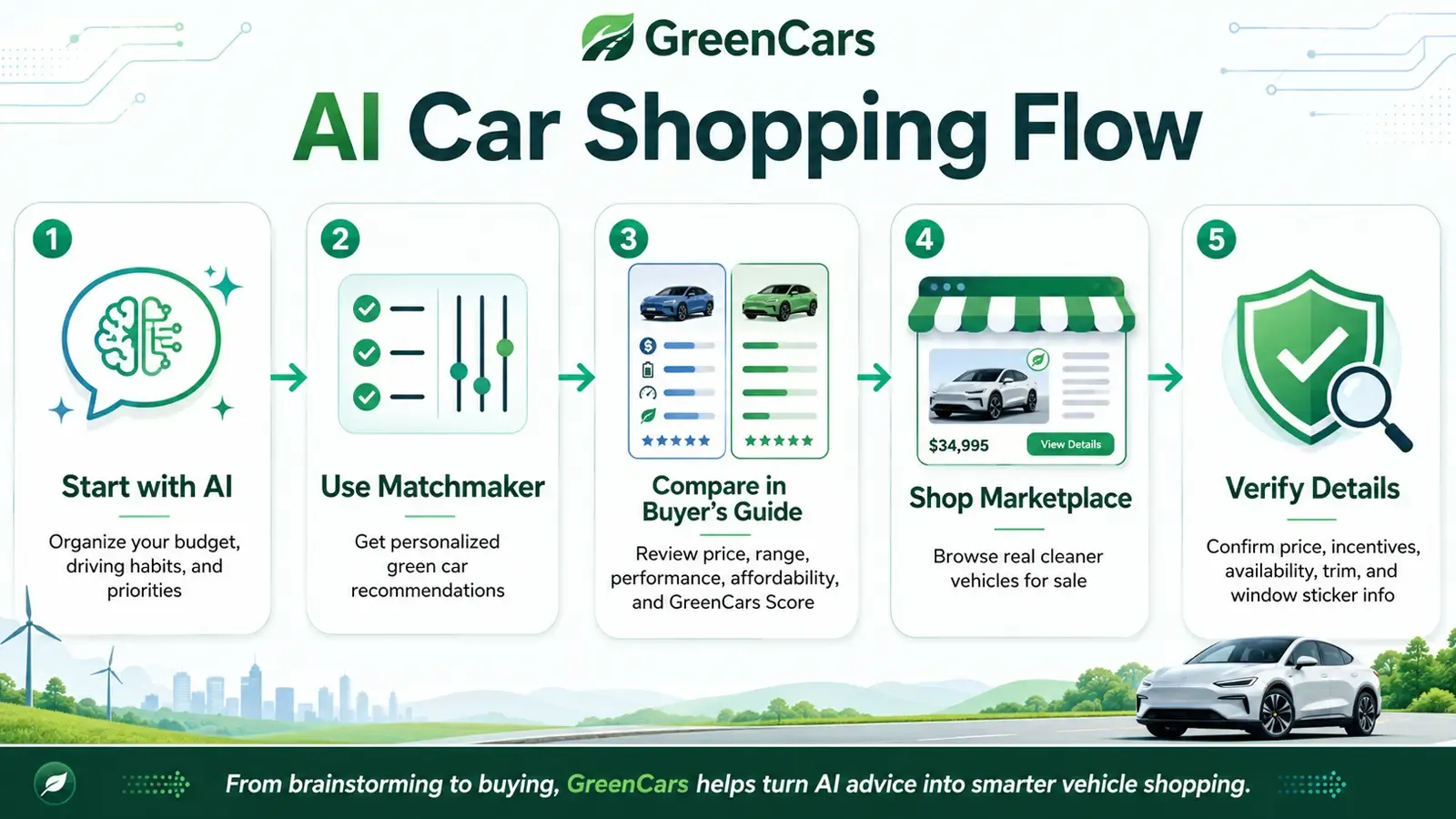
A simple shopping flow might look like this:
1. AI: Brainstorm and narrow your options based on lifestyle
2. GreenCars Matchmaker: Get recommendations based on your preferences
3. GreenCars Buyer’s Guide: Compare vehicles side by side by price, performance, range, affordability, and Greencars Score
The GreenCars Matchmaker is built to help shoppers find a green car based on lifestyle and preferences, while the GreenCars Buyer’s Guide lets you compare electric cars, plug-in hybrids, and hybrids by practical shopping factors like price, performance, range, affordability, and GreenCar Score.
That combination is powerful. AI can help you translate your life into a shopping brief. GreenCars can help you compare real options.
LLM's are the brainstorming partner. GreenCars is the research garage.
A Prompt for Comparing Two Finalists
Once you have narrowed your list to two or three vehicles, try this:
- I’m considering [Vehicle A] vs. [Vehicle B].
- I found [Vehicle A] at [Dealer X] for $[price].
- I found [Vehicle B] at [Dealer Y] for $[price].
Compare these vehicles based on my priorities:
[Example: monthly cost, range, charging convenience, family space, reliability, comfort, road trips, resale value]
- What questions should I ask the dealer?
- What hidden costs should I watch for?
- What should I verify before choosing?
- What would be a reasonable negotiation starting point?
This kind of prompt can help you prepare for the human part of car buying: asking better questions, understanding trade-offs, and not getting hypnotized by a shiny monthly payment.
The Bottom Line
AI will not magically find the perfect car for everyone. It will not know your driveway, your budget anxiety, your road trip habits, your kid’s soccer schedule, or whether you secretly hate touchscreens.
But it can help you organize the decision.
For electric, hybrid, and plug-in hybrid shoppers, that matters. These vehicles can be excellent choices, but the right fit depends on how you drive, where you charge, what you can afford, and what you need from your car every day.
Start with AI. Ask better questions. Stress-test the answers. Then use GreenCars tools to compare the vehicles that actually fit your life.
The future of car shopping may be more intelligent, but the best decision still starts with something refreshingly human: knowing what you need.
Ready to Put AI’s Advice to Work?
Shop Cleaner Vehicles Nationwide
Browse real EVs, hybrids, plug-in hybrids, and fuel-efficient vehicles available now through the GreenCars Marketplace.
Start Shopping ➜
Compare EVs, Hybrids, and Plug-In Hybrids
Use the GreenCars Buyer’s Guide to compare price, range, performance, affordability, and GreenCars Score side by side.
Compare Vehicles ➜
Find the Right Green Car for Your Life
Use the GreenCars Matchmaker to get personalized recommendations based on your driving habits, budget, lifestyle, and preferences.
Get Matched ➜




 Announcements