
Fast Facts | Microgrids and EV Infrastructure Resilience
⚡ Core Idea: Microgrids can store and manage electricity locally to support buildings, EV chargers, and the larger grid
🏢 Grid Pressure: Rising electricity demand from data centers is adding stress to the power system
🔋 Energy Storage: Delta Electronics’ Plymouth facility uses 2.8 megawatt-hours of stationary energy storage
☀️ Solar Power: The facility includes 425 kilowatts of solar generation
🔌 EV Charging: The site supports eight Level 2 EV chargers and one 400-kW DC fast charger
📉 Peak Shaving: Microgrids can reduce electricity costs by using stored power during high-demand periods
🏗️ Expansion Plan: Delta plans to scale the system to 10 to 20 megawatts, about five times larger than the current setup
🛡️ Resilience: Microgrids could help reduce outages, support charging, and make local electric infrastructure more flexible
Electric vehicles are a cleaner, more convenient way to get around compared to traditional gas vehicles: zero tailpipe emissions, the ability to hit the road every morning with a "full tank," and saving big bucks over a lifetime of skipped gas station stops. But there's a growing threat to all that: the strain on America's power grid.
Big Data, Bigger Problems
As massive data centers pop up across the U.S. like mushrooms after a spring rain, the nation’s electrical grid is being pushed to its limits. S&P Global estimates that electricity use jumped 22 percent in 2025 compared to the year before, and demand is projected to nearly triple by 2030. Because of this, electricity generation and distribution may fall far short of what's needed. Data centers' increased demand won't just affect EV charging, either. In a worst-case scenario, homes could lose access to electricity altogether.
This is where microgrids could save the day. Think of them as large banks of batteries capable of powering whole buildings, or more. They can store electricity for use during outages or help lower power costs by drawing on stored energy during peak hours, something called peak shaving.
Dr. Charles Zhu, senior vice president and general manager of the automotive strategic business platform at Delta Electronics, describes a microgrid as a kind of subsystem tied to the grid. With power inverters, converters, and other advanced hardware and software, these systems can store energy and move it between battery banks and the larger power grid, plus a lot more.
Practicing What You Preach
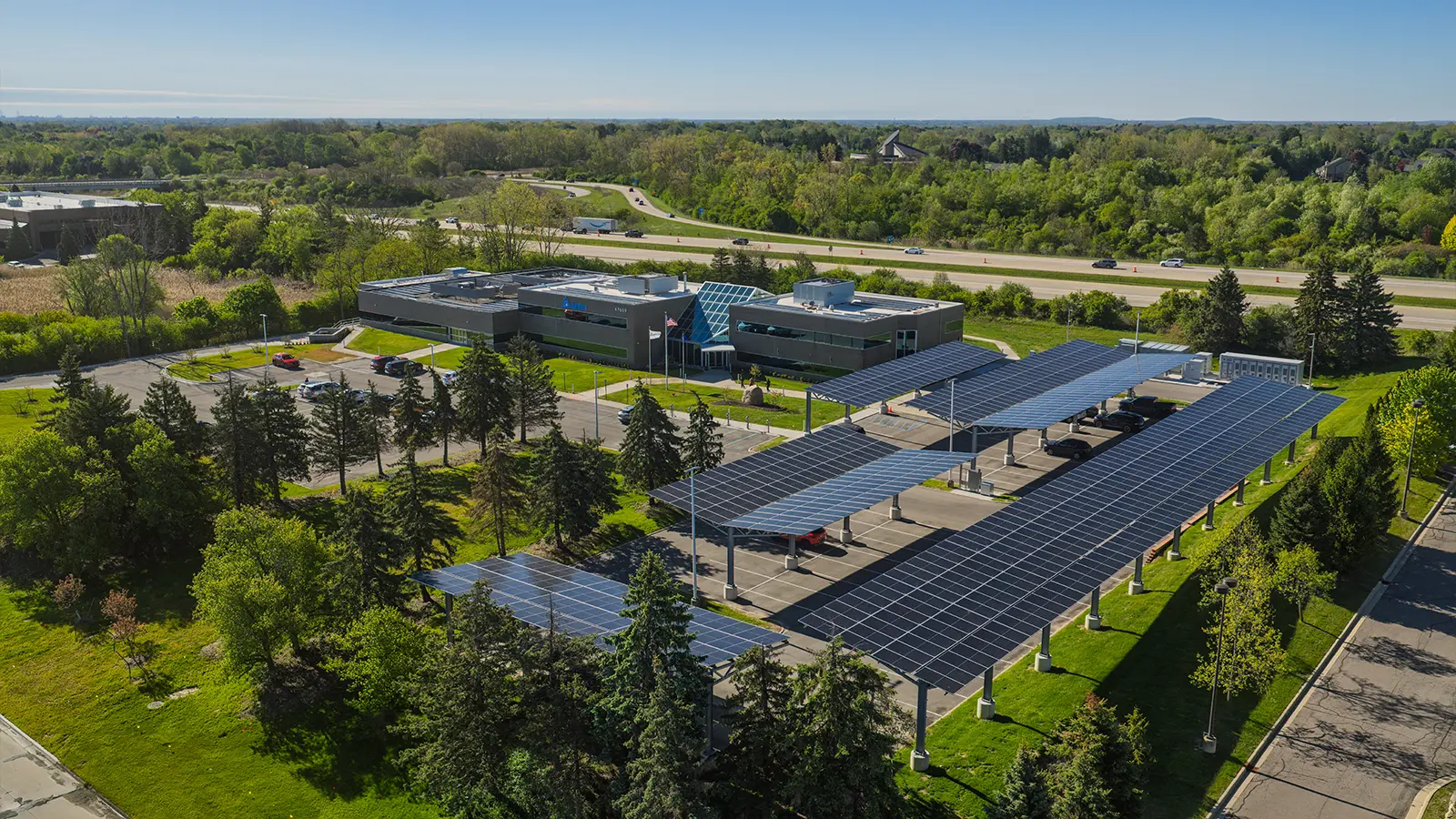
Delta Electronics has a working microgrid at its facility in Plymouth, Michigan, a suburb about 20 miles west of Detroit. Zhu explained that the project was started in an effort to make the building more green. The office signed up for RE100, a global initiative committing companies to 100 percent renewable energy by 2030, and on-site power generation is a big part of how they got there (four years early).
Microgrids matter for EV owners because charging costs depend heavily on where, when, and how electricity is delivered, and this EV charging cost guide explains that ownership math in plain English ➜
Delta Electronics' microgrid includes a 13.2-kilovolt connection to DTE Energy, the local electric utility, as well as a power conditioner, a solid-state transformer, 2.8-megawatt-hours of stationary energy storage, and 425 kilowatts of solar power generation. In the sunniest months, that's enough to make the building net zero in energy consumption. Over a full year, the solar panels reduce the building’s power consumption from the grid by around 50 percent, an impressive reduction, especially when you consider the site also has eight Level 2 electric vehicle chargers and a 400-kW DC fast charger for employee and visitor EVs.
Michigan winters can be long, cold, and dark, which might make you think solar panels become completely useless, but that's not the case at all. As long as the panels aren't covered by the snow, they can still generate a good amount of power.
Microgrid to Macrogrid?
Delta Electronics plans to expand the existing microgrid significantly. Construction starts soon, with the goal of completing the installation by the end of the year, and the system is expected to be in operation in Q1 2027. When it is, it'll scale up to 10 to 20 megawatts, which is five times larger than what's currently installed.
So why go so much bigger if the existing setup is already covering around half of the building's annual power needs? The short answer: AI.
Rapid data center expansion is one of the biggest issues the U.S. faces today, as the way these data centers use electricity is fundamentally different from other buildings or industries. When the graphics processing units (GPUs) in a data center really kick in, they can cause a sudden, massive spike in electricity demand that most utilities aren't built to handle.
To properly test the hardware and software Delta Electronics develops for these applications, the company needed a much larger setup of its own. Soon, the team will be able to test black-start scenarios, off-grid switching, and grid-loss recovery without requiring a physical MW-scale load on site. Beyond solar, the microgrid will add a 300-kW gas turbine to study how solar, storage, and gas generation interact as grid conditions change. And looking further ahead, Zhu says they'll incorporate a supercapacitor bank for even faster load response. Unlike batteries, capacitors can absorb and release energy very quickly, making them ideal for handling those dramatic GPU-driven spikes.
Microgrids to the Rescue
The microgrid at Delta Electronics' facility can power the entire building from sustainably generated electricity, charge electric vehicles, and, during less optimal weather or peak times, even reduce the company’s electricity costs during peak demand periods. As data centers and other industries, including automotive, consume more and more power, microgrids could help meet this growing demand without causing service interruptions.
A perfect example of this is Ann Arbor, Michigan, where Zhu lives. He said the city was running short of power, so DTE made a range of upgrades to the local grid, a huge project that took months to complete. But a mature microgrid could have offered an alternative. As Zhu explains, a traditional transmission line has to be sized for peak power demand, but with a microgrid, you can size it for the average power draw. This means less material and lower cost.
Microgrids could soon become an integral part of the overall electrical grid in the U.S. The benefits these systems provide are numerous, whether you drive an EV or not.
⚡Smarter Energy for Electric Driving
How EV Charging Works: A Beginner’s Guide
A helpful next read for understanding how electricity moves from the grid or another power source into an EV battery.
Read More ➜
Level 1, 2, and 3 Charging Explained
This guide breaks down the charging levels that microgrids may eventually help support at homes, workplaces, public stations, and fleet sites.
Read More ➜
EV Charging Connectors and Adapters Explained
A useful follow-up for readers who want to understand the hardware side of charging, from plugs and ports to compatibility across networks.
Read More ➜