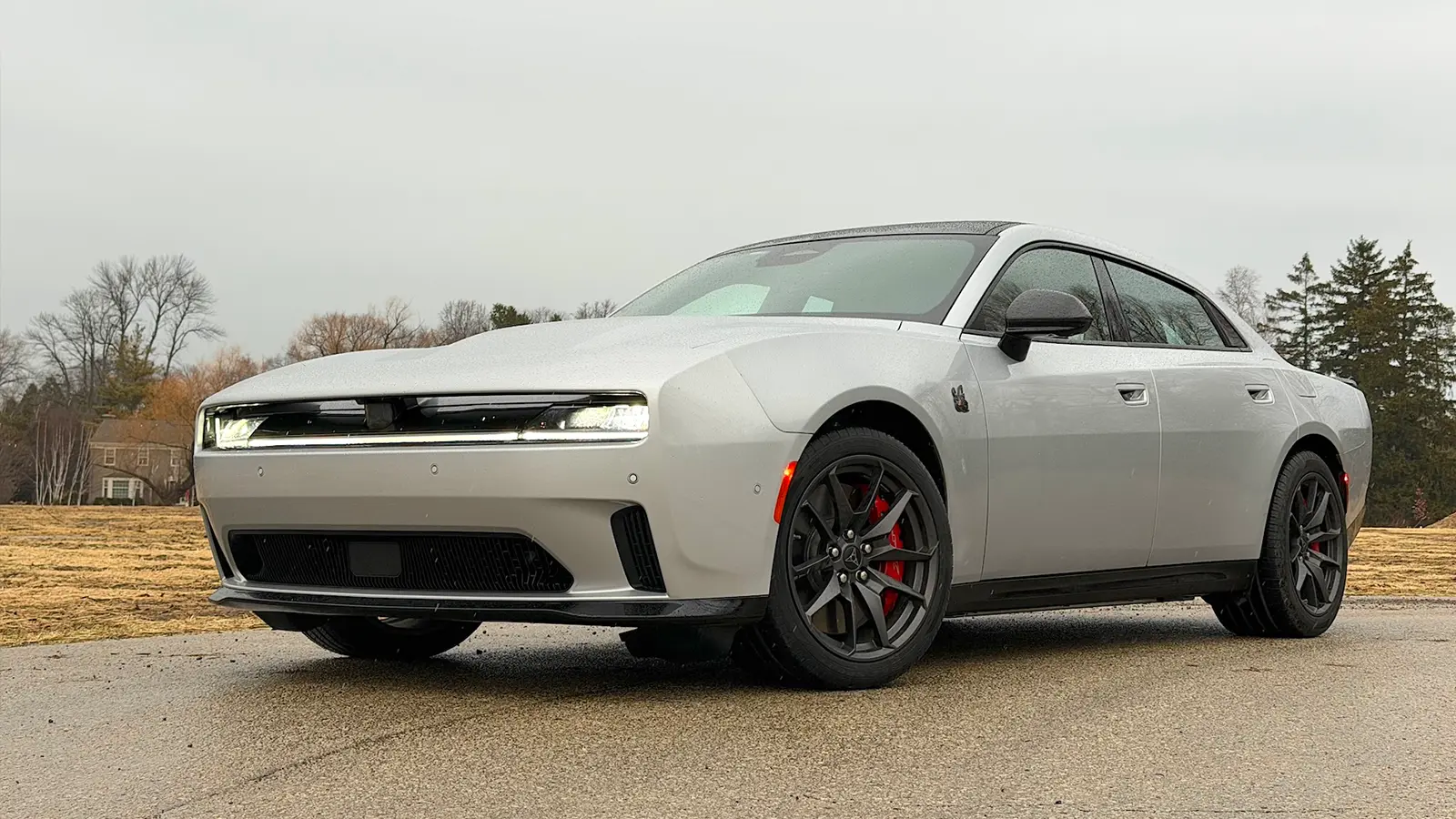

Fast Facts | 2026 Dodge Charger Daytona Scat Pack
⚡ Power: 630 horsepower standard, 670 horsepower with Drag or Power Shot
🛞 Drivetrain: Dual motors with standard all-wheel drive
⏱️ Performance: Dodge quotes 0–60 mph in 3.3 seconds and quarter-mile potential in the mid 11s
🔋 Battery: 93.9 kWh pack with up to 295 miles of estimated range in base tune
⛽ Efficiency: Track Pack drops range to 223 miles; observed efficiency around 2.0 mi per kWh in cold weather
⚖️ Curb Weight: About 5,828 pounds, on a 121-inch wheelbase
💰 Price: Scat Pack starts around $63,990 MSRP; test car priced at $80,455 with options
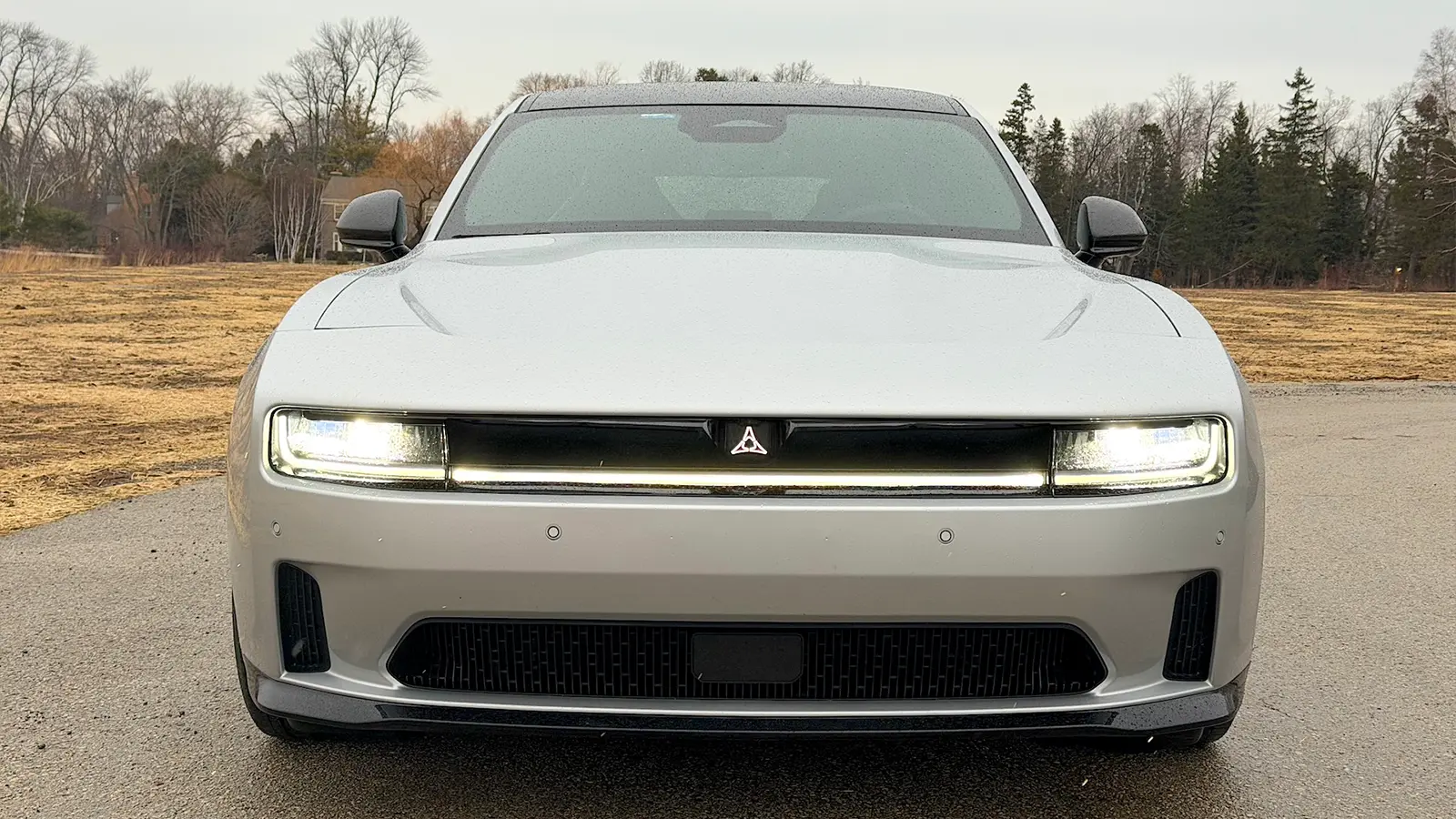
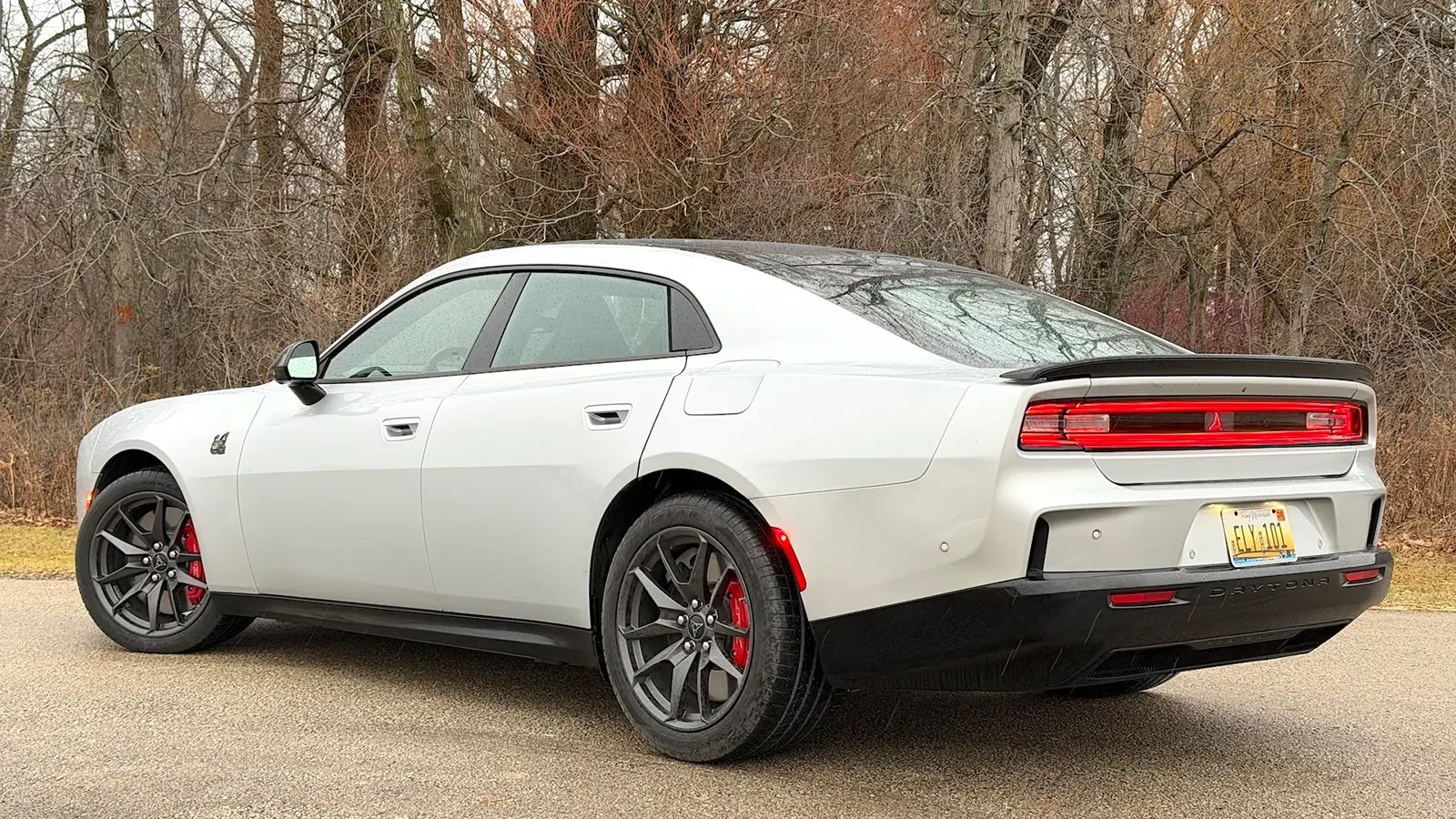
The 2026 Dodge Charger Daytona may be an electric car, but it announces its muscle car aspirations from the get-go. If you’re not convinced by its modern take on 1968 Dodge Charger styling, the burble from the Fratzonic “exhaust” will likely make you believe. If you still need more convincing, the wide-and-wider tires of the available Track Pack will clue you in. And if all that fails, getting behind the wheel and mashing the throttle will have you sold.
The Charger Daytona brings Dodge’s typical muscle car aesthetic to the electric car era. However, after a week driving the Charger Daytona Scat Pack with the Track Pack and summer performance tires - the least efficient but best-performing version - I found it aims more for style and performance than efficiency.
Straight-Line Performer
Like many high-power EVs, the Charger Daytona Scat Pack’s main strength is straight-line performance. Every Charger Daytona gets dual motors and all-wheel drive for 630 horsepower and 627 pound-feet of torque, and both a Drag mode and a Power Shot feature boost that to 670 horsepower for 10-second bursts.
Dodge quotes a 3.3-second 0-60 mph time, and the best way to achieve that is in Drag mode with Launch Control. Drag mode slows steering response, dials in full regenerative braking, and sets the adjustable front dampers to full firm and the rears to full soft for better traction. In this mode, the power hits hard from a stop. The thrust snaps you back into your seat, all four tires hook up, the Fratzonic “exhaust” sound grows louder and deeper, and the scenery blurs.
By the way, Fratzonic isn’t really an exhaust system; it’s a subwoofer below the rear bumper that belts out artificial V8-inspired sounds. Fratzonic reacts to throttle position and sounds more realistic inside the car than out. It can reach 126 decibels (as loud as a Hellcat V8), and you can turn it off if you want.
If you want to see how the Charger Daytona stacks up against other high-power electric cars on range, performance, and price, the GreenCars Buyer’s Guide is a quick way to compare specs side by side ➜
At a Dodge event in December 2024, I put up an 11.87 elapsed time at 117.23 mph and had to use the Launch Control’s Low torque setting even though I was on a dragstrip. Dodge quotes an 11.5-second ET, which seems quite possible on a prepped dragstrip surface.
During my recent loan during a Wisconsin winter, I didn't hit any dragstrips, but that power proved accessible and not excessive, unless I wanted it to be. I seldom changed from the standard Auto mode, though for more pep, I occasionally switched to Sport mode. In all modes, power delivery felt natural and controllable, and the car was easy to drive in heavy traffic without being jerky or high-strung.
While the Daytona can get an EPA-estimated 295 miles of range from its 93.9-kilowatt-hour battery, the Track Pack’s performance tune and wide tires drop that to 223 miles. During my week with the car, with temperatures in the 20s, it topped out at 203 miles of range, according to the computer. Over 115 miles of mixed highway and city driving, I averaged 0.5 kWh per mile, which pens out to 2.0 mi/kWh.
With a 400-volt battery, the Charger can charge at speeds of up to 183 kW on a 350-kW DC fast charger, which takes it from 5 to 80 percent in 32.5 minutes. On a Level 2 home charger, it can charge at up to 11 kW.
Heavy Cruiser
The Charger Daytona is a comfortable cruiser, even with the Track Package’s “competition”-tuned suspension. That’s thanks to a long 121-inch wheelbase and adaptive dampers with a range of tuning options. The Sport and Track settings firm up the ride, but it’s still quite livable.
Dodge does a good job of integrating the regenerative and friction braking. The brake pedal boasts a natural feel, and I never detected the handoff from regen to friction. Three levels of regen allow drivers to choose what fits their tastes. Level 3 is close to one-pedal driving, but it’s still important to use the pedal to come to a complete stop.
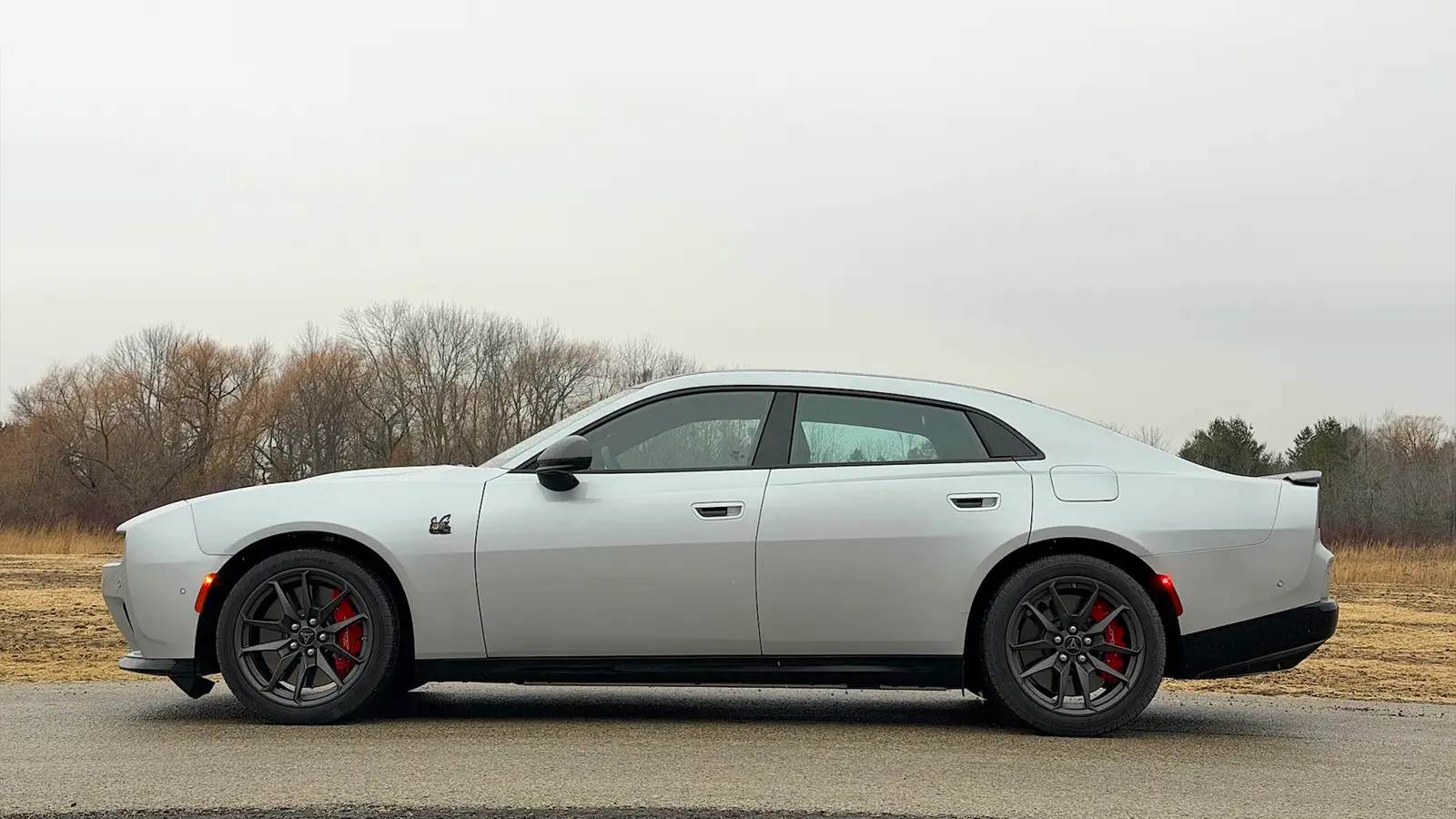
At 206.6 inches long, it is a big car, 5.5 inches longer than the last-generation internal-combustion Charger. It’s also very heavy at 5,828 pounds. In everyday driving, the size and weight aren’t detrimental, other than perhaps when parallel parking. It’s easy to place the car because the steering is direct but a little too light for my taste. Changing to the Sport or Track modes adds some appreciated steering weight.
Take the Charger Daytona on a canyon road or even to a track, and the size and weight may become an issue. Charge into a corner, and the car can feel a bit top-heavy, with notable body lean. Get it under control with the brakes, however, and it rotates well.
With the Track Package, though, it can handle some track time. This package swaps a set of 305/35ZR20 tires for staggered tires with 325/35ZR20s at the rear, though they’re still Goodyear Eagle Sport All-Seasons. For best performance, Goodyear Eagle F1 Supercar 3 summer tires are available.
Stylized Interior
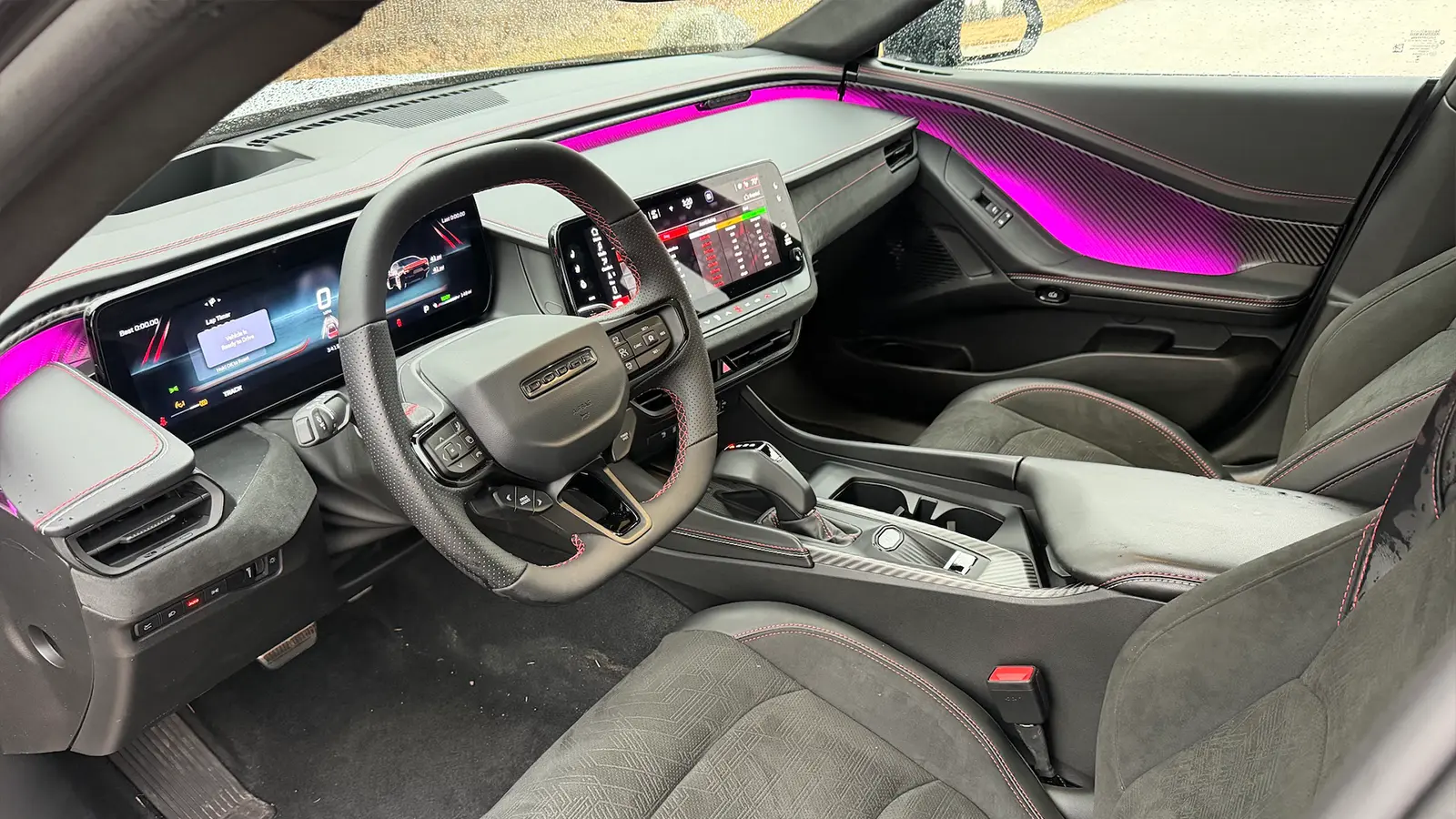
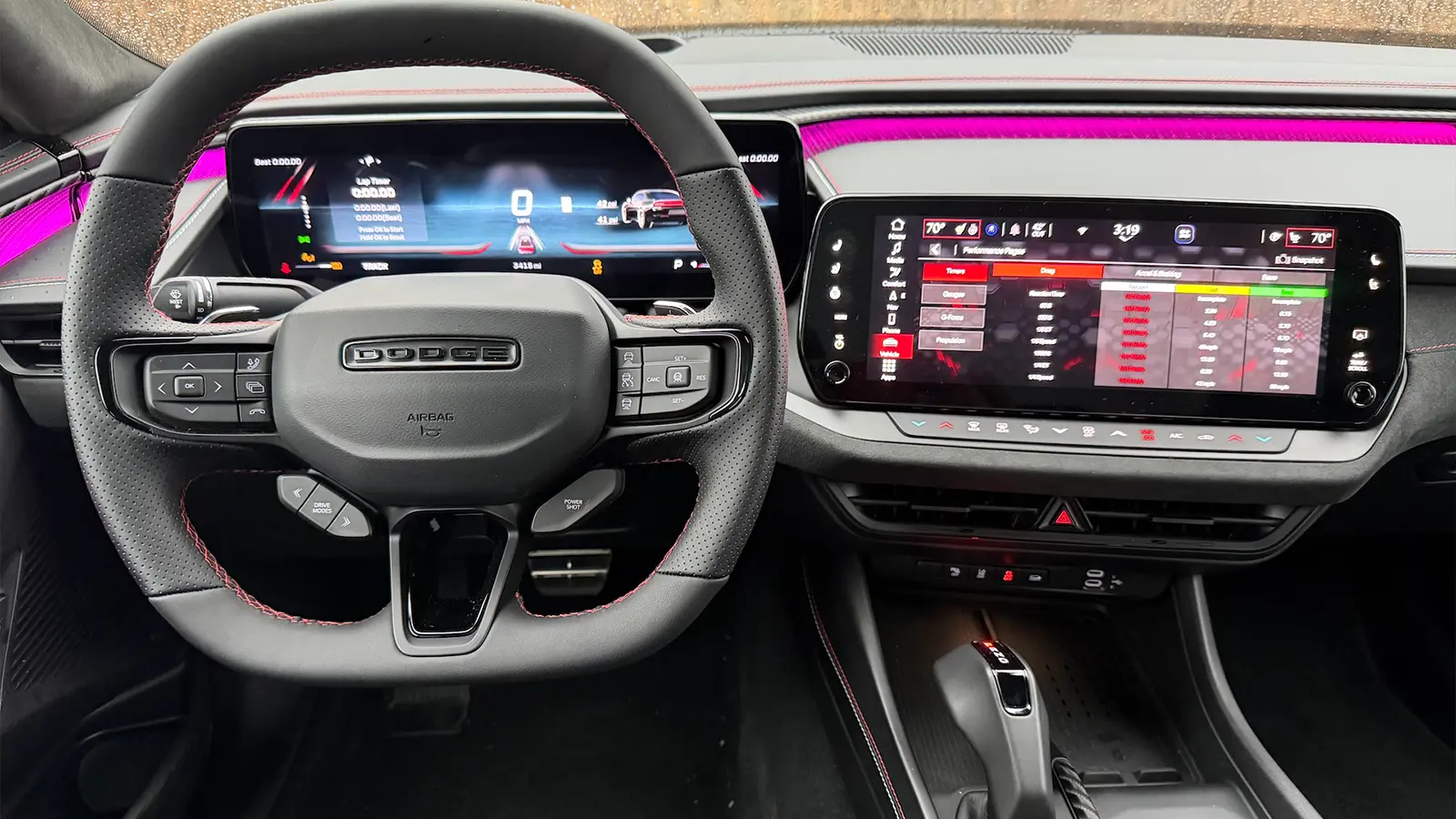
As overtly muscular as the exterior is, the interior is just as stylized. It has Dodge’s typical dark dash, floors, and headliner, but it’s brightened by prominent ambient lighting and the available Demonic Red leather upholstery. A steering wheel that’s squared off top and bottom looks sporty, and a pistol-grip shifter imparts a tinge of nostalgia.
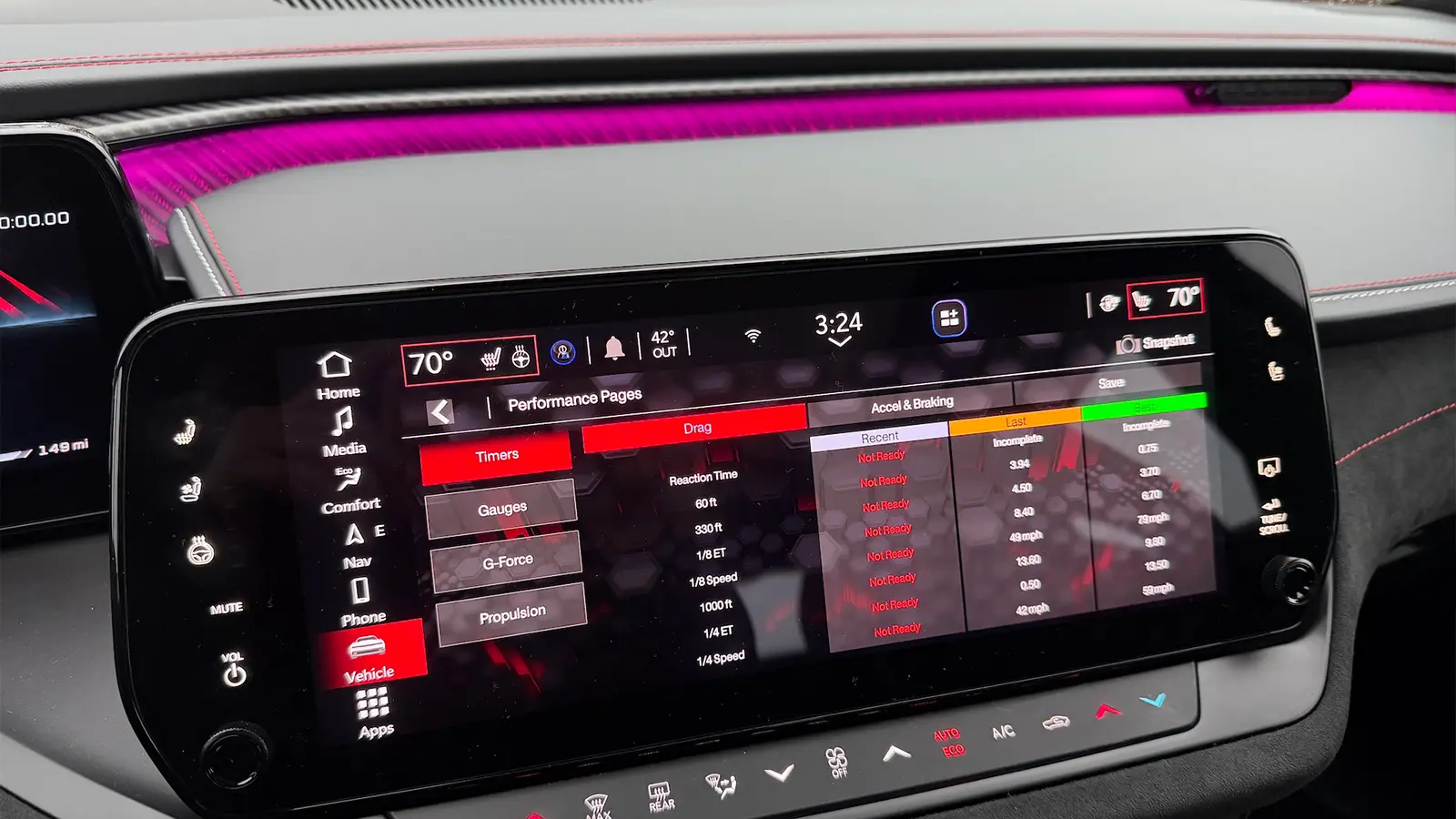
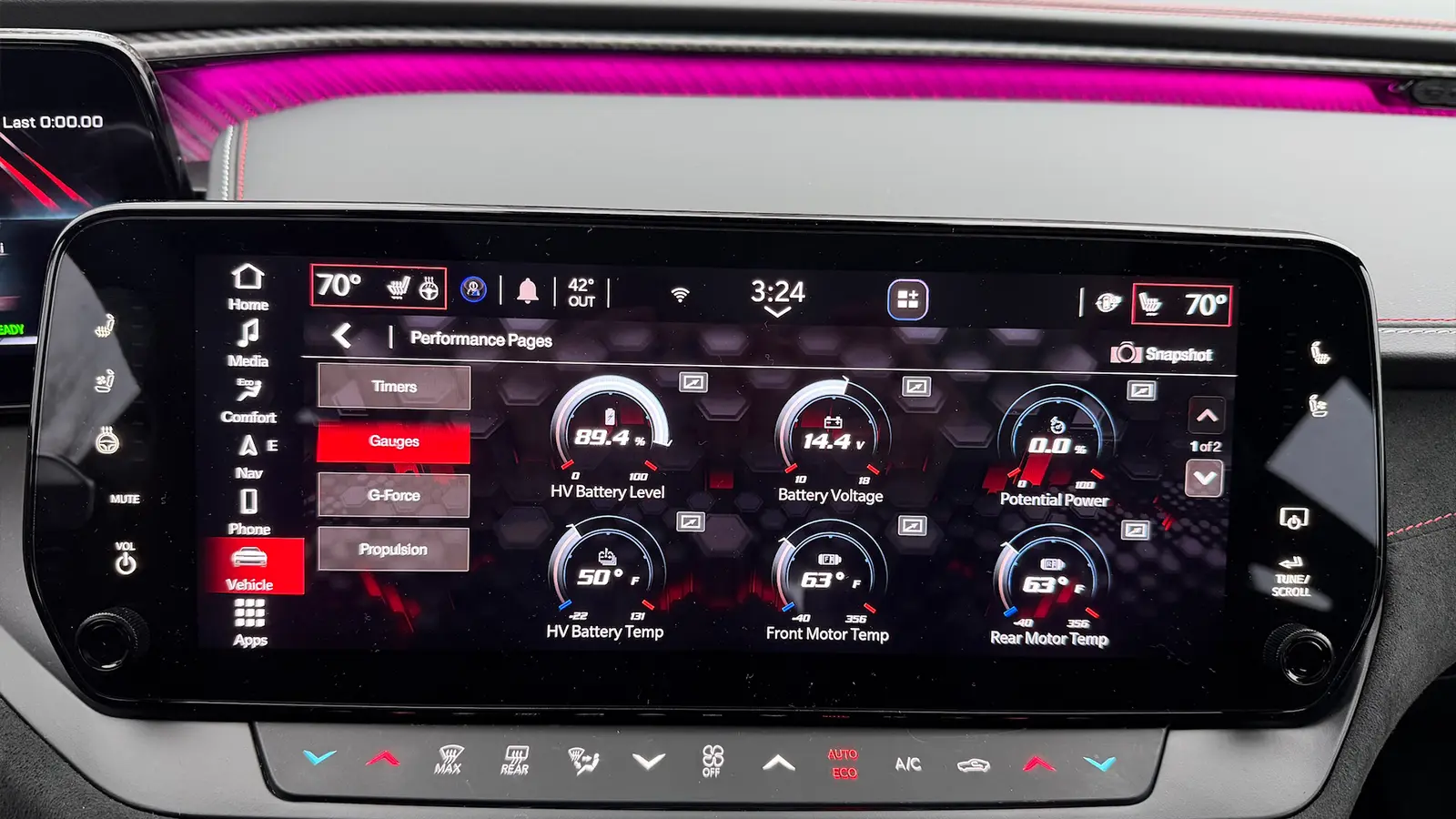
A standard 12.3-inch infotainment touchscreen teams with a standard 10.25-inch digital instrument cluster or an optional 16.0-inch unit to provide the modern technology. Performance Pages and EV Pages information in the touchscreen let drivers monitor timed runs, power figures, additional gauges, battery status, and efficiency stats, among much more information.
Dodge offers the Charger Daytona in two- or four-door body styles. Both have the same size rear seat with lots of legroom and just enough headroom for six-footers. It may look like a sedan, but it’s actually a hatchback with a healthy 22.8 cubic feet of cargo space with the rear seats up and 37.4 cubic feet with the rear seats folded flat. A small 1.5-cubic-foot front trunk is, oddly, optional.
Pricing
The 2026 Dodge Charger Daytona Scat Pack starts with an MSRP of $63,990, including a $1,995 destination fee. As equipped, my tester cost $80,455 MSRP thanks to the $4,495 Track Package, $695 summer tires, a $2,495 Sun and Sound package, a $1,995 Carbon and Suede package, and a $4,995 Plus Group with enticing amenities such as ventilated front seats, wireless smartphone charging, and a surround-view camera system.
That’s a lot of money to spend on an electric car that’s not very efficient, but efficiency isn’t the point here. The Charger Daytona is about muscle car style and performance, and the electric propulsion just means it belches out far fewer emissions than the muscle cars of the past.
More Electric Muscle to Compare
2024 Ford Mustang Mach-E GT Road Test
A performance-focused electric Mustang that delivers big power, sharp handling, and a more traditional sports-sedan feel than most EVs.
Read More ➜
2025 Chevrolet Blazer EV SS Adds Muscle
Chevy’s hottest Blazer EV brings aggressive styling and serious output to the electric crossover segment for drivers who want speed with space.
Read More ➜
Can the 2025 Dodge Charger Daytona Scat Pack Outrun Its Controversy?
An early deep dive into Dodge’s electric muscle car experiment, exploring whether performance can overcome skepticism about an EV Charger.
Read More ➜