
Fast Facts | 2026 Toyota Tundra TRD Pro
⚡ Hybrid Output: 437 horsepower and 583 pound-feet of torque from Toyota’s i-Force Max setup
🛻 Powertrain Layout: Twin-turbo 3.4-liter V6 plus a 48-horsepower electric motor and 1.87-kWh battery pack
⛽ EPA Economy: The TRD Pro is rated at 19 mpg combined
🏕️ Off-Road Hardware: Lifted suspension, Fox shocks, locking rear differential, and chunky all-terrain tires
🛋️ Cabin Strength: Huge crew-cab space, a big touchscreen, JBL audio, and heated and cooled front seats
💰 Price: Starts around $74,660 MSRP, with the tested truck landing near $79,000
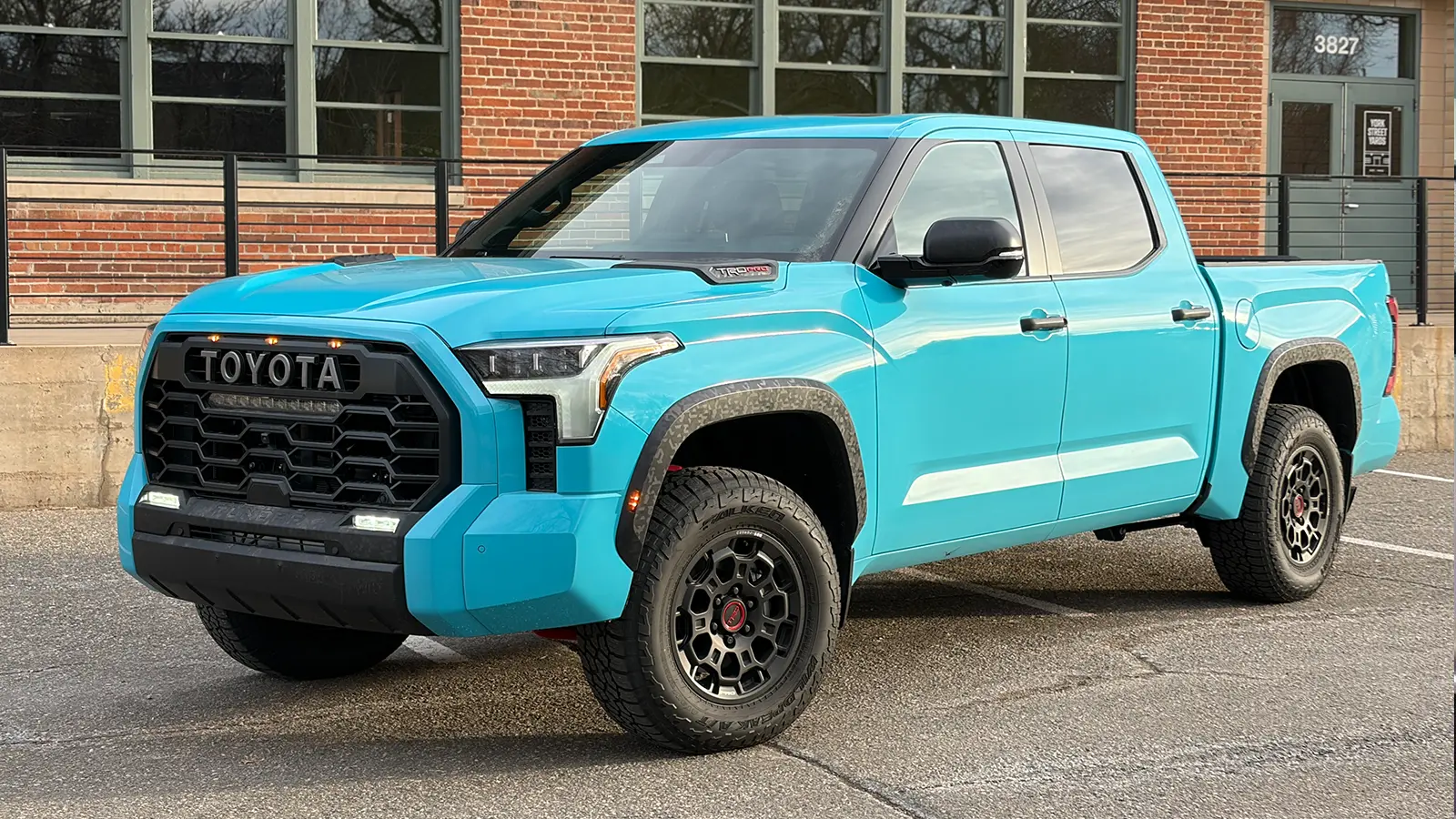
The 2026 Toyota Tundra TRD Pro is not your average hybrid. This full-size, crew-cab pickup pairs a twin-turbocharged V6 with a 48-horsepower electric motor fed by a 1.87-kilowatt-hour battery pack. Toyota calls this hybrid setup the i-Force Max, and it's available across a wide array of Tundra configurations. The result is a serious performance punch over the standard gas-only V6 bolted into lesser Tundras. In the flashy — and hugely capable — TRD Pro guise, the Tundra is also a burly off-roader.
Here’s what you need to know about the hybrid Toyota Tundra TRD Pro.
Smooth Operator
Every Tundra gets a twin-turbo 3.4-liter V6. In the base SR trim, it puts out 348 horsepower and 405 pound-feet of torque, while the SR5, Limited, Platinum, and 1794 Edition versions belt out 389 horsepower and 479 lb-ft of torque. That's plenty of muscle for most drivers, even if rivals like the Ram 1500 edge slightly ahead in horsepower.
Because mpg is one of this truck’s biggest tradeoffs, Today’s Most Fuel-Efficient Trucks adds useful context for where the Tundra TRD Pro sits in the broader pickup market ➜
The real ace up the Tundra’s sleeve or behind its blocky, angular grille is the i-Force Max setup, which integrates an electric motor into the drivetrain to bump total system output to 437 horsepower and a thundering 583 lb-ft of torque. Even with my TRD Pro tester tipping the scales at over 6,000 pounds, the Tundra vaults forward with authority. The ten-speed automatic fires off quick, smooth shifts, aside from the occasional low-speed stumble around town.
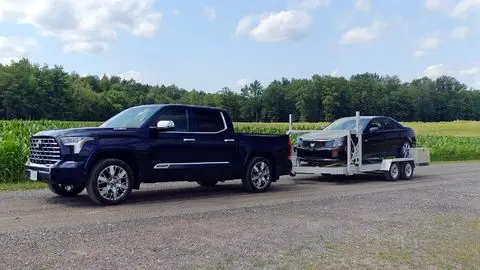
Aside from the base SR, these big Tundras are rated to tow at least 10,000 pounds, and most can lug upward of 11,000 pounds. Unlike many of its rivals, Toyota makes a trailer hitch standard, and it simplifies the buying process by offering a single rear axle ratio. Some competitors use multiple, confusing ratios that can make a dramatic swing in terms of tow ratings.
The fuel economy is, to put it kindly, less impressive. Using the EPA’s test procedures, the hybrid Tundra is estimated at up to 22 mpg combined, but my TRD Pro tester, riding on its big all-terrain tires and raised suspension, checks in at just 19 mpg combined. I saw closer to 15 mpg combined, which was, incidentally, about the same real-world fuel economy I saw in a (considerably less-quick) nonhybrid Tundra SR5 I recently sampled. The hybrid system helps offset the TRD Pro's added weight and capability, but efficiency is not its strongest suit.
Built for the Trail
Unlike many full-size trucks that use relatively archaic leaf springs, the Tundra features a coil-sprung solid rear axle, keeping it planted over bumpy terrain, even with an unloaded bed. TRD Pro models swap in a lifted front suspension to improve the departure angle and help with high-speed, off-road impacts, and they ride on special Fox shocks designed to soak up bumpy pavement, small boulders, and rutted trails.
The chunky all-terrain tires measuring around 33 inches tall make it obvious the TRD-Pro has off-road merits. A locking rear differential and multiple drive modes enhance its capability, though its over 80-inch width can make tight trails - and urban parking - challenging.
My test truck was fitted with the $2,999 TRD Performance package, which added a snarling exhaust and a modified air intake. While the amplified turbo whistle was fun at first, the exhaust’s incessant droning got old fast. Try before you buy.
Spacious and Comfortable
Inside, the TRD Pro ticked most of the feature boxes I’d expect for $80,000 or so: a big central screen with good software, JBL speakers, a digital instrument cluster, heated and cooled front seats with plenty of power adjustment, and a huge sunroof. Its perforated synthetic leather upholstery even has a hidden tech-camo design not visible from all angles, which is a nice touch.
That said, the hard plastic all over the dashboard, doors, and center console serves as a reminder that this truck leans more toward adventure, not luxury. Minor issues, like my tester's steering wheel not being stitched correctly at the top, stand out more at this price.
Space, however, is a clear strength. The crew-cab layout has almost enough space between the front and rear seats for a pair of jumpseats, and three abreast on the rear bench is perfectly feasible.
The Tundra features a composite bed, which resists denting and corrosion better than traditional metal beds. Higher trims have a power tailgate, which motors down quickly, various tie-down points, LED lights, and a power outlet. Tundras equipped with the optional surround-view camera system can also stream a live feed of the bed, which is handy for on-the-go checks to confirm your stuff’s still there.
Tons of Tech
The Tundra’s 14-inch touchscreen is bright and crisp, with a subtly rubberized coating that helps reduce the risk of scratches and makes finger-tracking a smidge more precise. The infotainment system is simple enough to sort through, at least once you’ve set all your audio presets. That process is a bit time-consuming, but generally only needs to be done once.
Toyota bakes in wireless Apple CarPlay and Android Auto, though its cloud-based navigation was so good that I only rarely chose to fire up Waze. There's a mix of USB-A and USB-C ports throughout the cabin for keeping devices charged.
All Tundras also come with a suite of driver-assistance tech, including adaptive cruise control that allows for very limited stints of hands-free driving. There is a subscription fee, and Toyota’s tech is no match for the hands-free capability of Ford’s BlueCruise or Chevy/GMC’s Super Cruise, but the system works well enough in normal driving.
For shoppers who want to compare truck size, capability, and price more directly, GreenCars Buyer’s Guide is the cleanest next step ➜
Toyota also charges for some smartphone app functions like remote start after an initial trial period, though you can still do it with the key fob.
For Most, The Limited Will Do Just Fine
The TRD Pro starts around $74,660 MSRP, and my tester’s TRD Performance package and a host of smaller accessories like a bed mat and a spare tire lock elevated it to nearly $79,000.
Most of the Tundra TRD Pro’s four-wheeling bits will go mostly unused by the typical driver. If the occasional dirt road is about as adventurous as you get, consider the Tundra Limited with the i-Force Max hybrid powertrain and four-wheel drive, which comes to an MSRP of $63,655. (Toyota doesn’t currently offer the hybrid setup in its lower-end SR and SR5 trims.) That’s a lot of cash, but it also buys a lot of truck: the big 14-inch screen with cloud-based navigation and wireless smartphone projection, plenty of driver-assistance tech, and leather seats with heating and cooling up front.
Compared to the Limited, a Ram 1500 Laramie runs slightly more for less power, and a hybrid Ford F-150 Lariat will cost you north of $70,000. Do the math, and the Tundra i-Force Max can be quite a good buy, especially if lots of power matters more to you than mpg numbers.
⚡ More Truck Power and Efficiency Stories
Comparison: 2026 Toyota Tundra Hybrid Vs. 2026 Ford F-150 Hybrid
Toyota’s hybrid truck formula looks very different once you line it up against Ford’s more efficiency- and feature-focused approach. This comparison gives useful context for where the Tundra TRD Pro fits in the broader hybrid truck landscape.
Read More ➜
Best Green Trucks of 2026: Hybrid and Electric Pickups Ranked
Electrified pickups are heading in several different directions, from fuel-saving hybrids to full EVs. This roundup helps place the Tundra TRD Pro in the wider truck market and shows how it stacks up against other greener options.
Read More ➜
2025 Ford F-150 PowerBoost Lariat Review
Ford’s PowerBoost takes a more practical, feature-rich approach to hybrid truck ownership, making it a strong counterpoint to the Tundra TRD Pro’s more off-road and performance-focused personality.
Read More ➜