
Fast Facts:
- The development of Ford’s Universal EV Platform aims for efficiency through light weight, fewer parts, and slippery aerodynamics.
- The DC-to-DC converter and AC-to-DC charger will be included in one unit called the E-box.
- The LFP battery will feature a multi-function single-piece flexible circuit board.
- Aerodynamic design will direct air over the vehicle in a teardrop shape, effectively skipping over the bed.
In August, Ford announced a new Universal Electric Vehicle Platform (UEV) designed to underpin a series of electric vehicles (EVs). The first model will be a midsize pickup truck, expected to launch in 2027 as a 2028 model, with a target price of an MSRP of$30,000. Now, Ford has outlined some of the methods the company is using to ensure the truck is both efficient and affordable.
Ford representatives described using an ecosystems engineering approach across design, product development, software engineering, supply chain, and manufacturing to rethink vehicle production. Each team was charged with putting bounties on targets and working together to meet and even surpass them. The company said the project’s integration goals aim at achieving cost parity with gas vehicles.
We already knew some of the ways Ford intends to keep the cost down. The UEV Platform will use unicastings with just two pieces for the front and rear subframes instead of the 146 used for the similarly sized but gas-powered Ford Maverick pickup. The UEV Platform’s electrical architecture will be reduced to just five zonal ECUs, and the wiring will cut out 4,000 feet and 22 pounds versus the wiring harness used in the brand’s first-generation electric SUV. A less-expensive lithium-iron-phosphate battery chemistry will lower costs as well as weight.
On Tuesday, Ford released more information on how it will pursue efficiencies in terms of aerodynamics, battery development, and power electronics. Let’s take a look at each category.
Ford UEV Battery Development
Ford said an EV’s battery can account for 40 percent of a vehicle's price and 25 percent of the weight. With those facts in mind, it makes sense to use as little battery as possible while still delivering the 300-plus miles of range customers expect.
The new EV’s lithium-iron phosphate chemistry, or LFP, is lower in cost than Ford's other EV batteries because it requires no nickel or cobalt. The battery will use prismatic cells that Ford says will be coupled directly to the vehicle structure. This construction will help make the vehicle quieter and the structure more capable of dynamic performance.
The battery pack will use a single-piece flexible circuit board that integrates the low-voltage, high-voltage, and thermal sensing connections. This reduces the hundreds of bus bars and wires normally used to one part.
Ford will build the battery cells at the BlueOval Battery Park in Marshall, Michigan, and the vehicle will be assembled at the Louisville Assembly Plant in Kentucky.

Ford UEV Aerodynamics
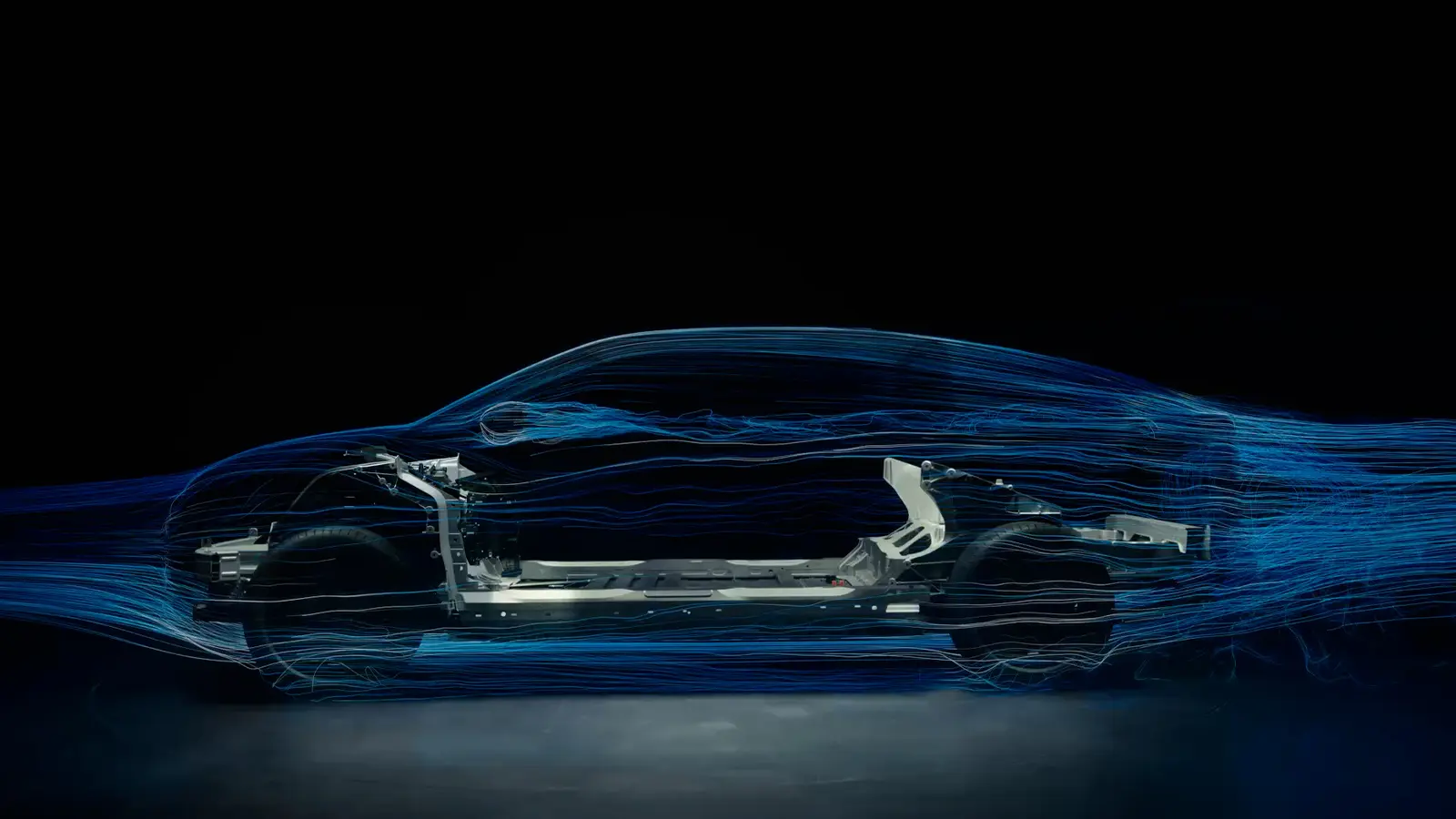
Ford paid attention to aerodynamics throughout the development process, and at least half of the team working on the project has experience in Formula One. The team has used a wind tunnel throughout the process rather than tweak a mostly locked-in design late in the process.
According to aerodynamicist Saleem Merkt, the team used Lego-like components to swap in 3D-printed and machined parts during the development — especially for the underbody shields, front fascia, and suspension components — to measure the effects of different shapes with wind speeds up to 87 mph.
The team streamlined the underbody with shallower bolt holes and shaped the components to direct air around the tires and suspension. Ford also sculpted the motor case, which is set low at the back of the vehicle, to let air pass under the vehicle uninterrupted. By steering the front tire wakes directly onto the rear tires, the aero team was able to essentially "hide" the rear tires from the wake so they wouldn't have to punch air of their own. Ford claims such changes result in 4.5 more miles of range.
More work was done to the body. The team sculpted the roof to direct air in a teardrop shape over the bed, leaving a virtual surface that the air skips over above the bed. “To the air, it's no longer a truck," Merkt said.
Rather than two motors in the side mirrors, one to adjust the glass and another to fold the mirror housing, Ford went with just one motor that moves the entire body of the mirror. This allowed the mirrors to be more than 20 percent smaller than conventional mirrors, though the glass is the same size. The smaller size and aerodynamic shape add a claimed 1.5 miles more range.
All told, Ford says the aerodynamic design will save $100 in battery cost because less battery is needed. Ford claims that if this battery were used in the most aerodynamic gas-powered midsize pickup on the market, its EV would have almost 50 more miles or 15 percent more range, and would be 30 percent more efficient at speed.
In addition to aero, Ford worked to reduce mechanical friction in every bearing, seal, and joint, and to make the regenerative braking more efficient. The position of the drive units reduced the angle of the halfshafts so they would last longer and minimize friction.

Ford UEV Power Electronics
Ford is doing more than just moving to a zonal architecture. The company is also using a 48-volt electrical system instead of a 12-volt system, which reduces the amount of copper used for the wires. In addition, the DC-to-DC converter, which converts the 400-volt battery’s output to 48 volts, will share a circuit board and components with the AC-to-DC charger, resulting in fewer components. This module, called the E-Box, handles power distribution and battery management, and can provide AC power to an owner’s home. The in-house-designed and compact power electronics module will be built right into the battery pack.
Ford EUV: What’s next?
The other bit of new information Ford shared is that the first EUV product will use the next generation of the brand’s advanced driver-assistance systems, which Ford says will cost 30 percent less. That should give it the limited hands-free Ford Blue Cruise highway driving system when the vehicle arrives in 2027. The company says the system will then become capable of limited eyes-off, hands-free Level 3 autonomous driving in 2028.
There is much more to come, including the name, a design reveal, an on-sale date, the EPA range, the battery size, and charge times. Ford has hinted that two sedans, two- and three-row SUVs, and a small commercial van will be built on the same architecture. We can also look forward to the timing and design for those vehicles.
In the meantime, customers can rest assured that Ford is plowing forward with the ground-up development of a line of efficient and affordable EVs.
⚡ New Developments Worth Tracking
NEVI Charging Network Reboots in 2026
New NEVI guidance cuts red tape and lets states speed up EV charger deployments nationwide
Read More ➜
How Ionna is Improving the EV Charging Experience
A look at how Ionna aims to make public charging easier, more consistent, and more driver-friendly
Read More ➜
Ford’s $30K EV Pickup Aims to Make Electric Trucks Affordable for Everyone
Ford’s Maverick-sized $30K EV pickup debuts a new platform strategy focused on efficiency and cost parity
Read More ➜