

Fast Facts | 2026 Toyota Tundra Hybrid Vs. 2026 Ford F-150 Hybrid
🛻 Core Matchup: Both are full-size crew-cab hybrid pickups with twin-turbo V6 engines and 10-speed automatics
⚡ More Power: Tundra Hybrid makes 437 horsepower and 583 pound-feet of torque
📈 Better Efficiency: F-150 Hybrid is EPA-rated at up to 25 mpg combined in rear-wheel-drive form
🏋️ Payload Edge: F-150 tops out at 2,045 pounds, while Tundra peaks at 1,680 pounds
🚚 Towing Edge: F-150 can tow up to 12,400 pounds, while Tundra tops out at 11,450 pounds
🔌 Unique Ford Feature: F-150 Hybrid offers Pro Power Onboard with available 7.2-kW export power
🧭 Driver-Assist Advantage: Only the F-150 offers available BlueCruise hands-off, eyes-on highway driving
🏕️ Off-Road Hybrid Edge: Tundra TRD Pro is the only hybrid off-road halo truck between the two
Whether it's for towing a boat, snowmobiles, or a giant camper, for a rancher pulling horses and bales of straw, or for a contractor hauling tools and materials, full-size pickups play a major role in the American automotive landscape. Full-size, light-duty pickup trucks like the Ford F-150, Chevrolet Silverado, GMC Sierra, Ram 1500, and Toyota Tundra collectively sell nearly 2 million units every year. But for all their capability, fuel efficiency has never been their strong suit. That's starting to change. Two full-size pickups now offer strong hybrid powertrains that deliver the performance truck buyers expect without burning through quite as much fuel: the F-150 and Tundra.
Exterior Design and Dimensions
Most full-size trucks are pretty similar in overall size, and the Tundra and F-150 are no exception, but there are some key differences to note. Both are offered in multiple cab configurations, but the hybrid powertrain is only available with the four-door crew-cab variants. Both can be optioned with either a 5-foot-6 or 6-foot-6 long bed.
If you want the quick refresher before comparing powertrains, What Is a Hybrid Car? lays out the basics without the jargon ➜
The Tundra is slightly wider than the F-150, just 0.3 inches, but the TRD Pro off-road variant adds another 1.4 inches of width. Ford only offers the hybrid on standard-width versions of the F-150; the wide-body Raptors are limited to gas-only engines. The most noteworthy dimensional difference is ground clearance: The Tundra sits at least 0.4 inches higher than the tallest Ford.
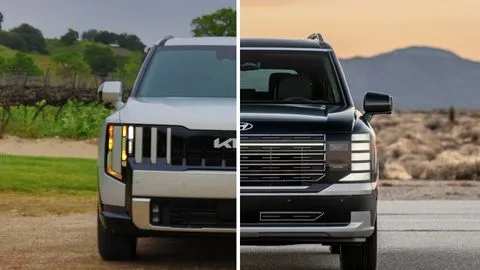
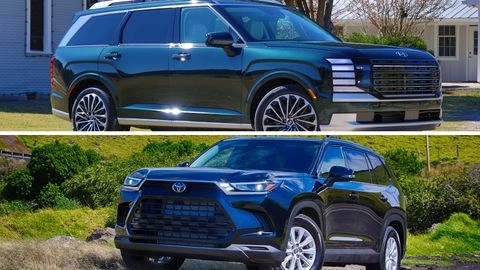
Design-wise, both of these are absolutely truck-shaped trucks — nothing off in left field like a Tesla Cybertruck. That said, the latest Tundra is a bit bolder, with aggressive fender sculpting and an enormous grille. The F-150 is a bit more conservative. One useful element Ford has carried through several generations is a belt-line cut down at the front of the door that significantly boosts visibility in the front corners when maneuvering in tight spaces.
Interior Space and Tech
Modern full-size crew-cab pickups offer almost limousine-like space inside for five adult passengers. However, Ford has a slight packaging advantage, with more leg and shoulder room front and back and more rear headroom.
Ford has a long history of selling trucks in the commercial market, and this experience has led to some clever features that are genuinely helpful for truck drivers. The center console-mounted shift lever folds forward into a cavity, and with it out of the way, the top half of the center armrest folds out to create a flat work surface across the console — perfect for eating lunch or generating invoices on a laptop. Ford also offers an in-vehicle safe for locking up valuables. The King Ranch and Platinum trims offer max-recline seats in the front that fold almost flat, handy for an after-lunch nap or a break on a long road trip.
Both trucks come standard with an array of driver assist features, including blind-spot monitoring, lane-keeping assistance, adaptive cruise control, automatic high beams, and more. However, only the F-150 offers a full hands-off, eyes-on highway driving system with BlueCruise. It's optional on the XLT and standard on Lariat, King Ranch, and Platinum trims.
Infotainment touchscreens are large on both: the Tundra gets a 14-inch display for its Multimedia system, while Ford uses a 12-inch screen for SYNC 4. Both offer wired support for Apple CarPlay and Android Auto, and the Tundra is also available with a wireless charging pad.
When it comes to the bed, the Ford has a 1.5- to 1.2-inch advantage in short and long bed configurations, plus 0.5 inches more bed height and an extra 1.9 inches between the wheel wells. Nonetheless, the Tundra's 48.7-inch bed width handles 4x8 sheets of plywood or drywall flat.
Ford offers a number of unique towing and hauling tech, including load sensors between the bed and frame to monitor payload and prevent overloading, and the Pro Trailer Backup Assist, which uses the rear camera to automatically guide the truck in reverse to align the hitch with a trailer.
Powertrain and Fuel Economy
Both trucks have very similar powertrains and outputs. Both use twin-turbocharged V6 engines with motor-generator units (MGUs) mounted inside a 10-speed automatic transmission. Toyota's 3.4-liter engine produces 389 horsepower and 479 pound-feet of torque, with the MGU bumping total system output to 437 horsepower and 583 pound-feet. Ford's 3.5-liter engine makes 400 horsepower and 500 pound-feet, with the MGU pushing the system to 420 horsepower and 570 pound-feet. Both are available with either rear- or four-wheel drive.
The Tundra has a slight edge in torque, but it’s also 400 to 500 pounds heavier than the aluminum-bodied Ford. The short-bed F-150 starts at 5,585 pounds, while the long-bed Tundra can reach as much as 6,185 pounds. That extra weight takes away some payload and towing capacity. The Tundra maxes out at 11,450 pounds for the short-bed rear-wheel drive variant and 11,175 pounds for the four-wheel drive. The rear-wheel-drive F-150 with the Max Tow package can pull up to 12,400 pounds and 11,600 pounds with four-wheel drive. On payload, the Tundra tops out at 1,680 pounds for the rear-wheel drive, long bed and 1,665 pounds with four-wheel drive. The F-150 can take up to 2,045 pounds on the rear-wheel drive model and 1,740 pounds on the four-wheel drive.
Because fuel economy is one of the biggest deciding factors here, Today's Most Fuel-Efficient Trucks gives a broader look at where these two pickups fit in the segment ➜
Another Ford-exclusive feature is Pro Power on-board. The F-150 hybrid comes standard with 2.4 kilowatts of export power through four 120-volt outlets in the bed, powered by the hybrid battery until it is depleted, then by the engine. A 7.2-kW version is also available that adds a 240-volt/30-amp outlet. These can be used to power a campsite or worksite without hauling along a generator and can also provide emergency backup power in the event of an outage.
One of the key reasons for getting a hybrid is improved fuel efficiency, but the addition of the MGU and battery also provides the potential for better performance. While Toyota is the industry leader in fuel-efficient hybrids overall, the system they use for body-on-frame trucks and SUVs is clearly biased toward performance over fuel economy. The four-wheel drive Tundra hybrid is EPA-rated at 20 mpg, just 1 mpg better than the gas-only version, and our real-world testing has rarely returned more than 18 mpg. The rear-wheel drive Tundra hybrid is rated at 21 mpg combined. The four-wheel F-150 hybrid is EPA-rated at 23 mpg and typically returns at least that much and sometimes significantly more, while the rear-wheel drive F-150 is EPA-rated at 25 mpg combined.
Price
The Tundra's hybrid powertrain starts at the more premium Limited trim, and even the base rear-wheel drive short-bed version comes in at nearly $5,000 more than the F-150 STX, which is more basic inside but includes four-wheel drive. As you move up the lineup, pricing gets closer between similarly equipped models. But if you want hybrid efficiency without paying for a lot of premium features you may not need, the F-150 STX is definitely the sweet spot.
Ford told us the rear-wheel drive F-150 will be available with a hybrid powertrain, though they haven't released pricing yet.
What's It Like to Drive?
The overall driving experience of both of these trucks is pretty similar, and buyers of either one are unlikely to feel disappointed. The driving dynamics of modern trucks have improved by leaps and bounds over the last 25 years, and while they may get a bit bouncy with an empty bed on a rough road, they can still be decent daily drivers.
The downside to using these trucks as a daily driver is the sheer size. They're hard to maneuver, especially in tight parking lots, garages, and urban centers. Outward visibility is limited in both, though Ford's front corner design gives it a bit of an advantage, and the Tundra offers a digital rearview mirror. Both trucks are far more efficient than similarly sized trucks from 10 to 15 years ago. For those who need to haul a family or crew of up to five, back seat room and storage are exemplary in both, and you still get the ability to bring along a large travel trailer.
Analyst's Perspective (Which One's Right for You)
Having spent time with both the Tundra and F-150 hybrids, unless you’re particularly enamored with the Toyota’s looks, the F-150 will probably be the better choice for most buyers. It has the edge, albeit a modest one in most cases, in hauling and towing, gets significantly better real-world fuel efficiency, and comes with valuable features unavailable on the Tundra, like Pro Power On-Board, Trailer Backup Assist, and payload sensors. However, for those who need a more off-road capable truck, the Tundra TRD Pro is the only one available as a hybrid, since the F-150 Tremor and Raptor variants are gas only.
More Hybrid Truck Reads
GreenCars Buyer’s Guide
Truck shoppers balancing fuel economy, capability, and price can use the Buyer’s Guide to compare which setup fits their needs best. It is a useful way to sort through full-size pickups without guesswork.
Read More ➜
Toyota Tundra TRD Pro Hybrid Road Test
Toyota’s hybrid truck takes on a different personality in TRD Pro form, with more off-road attitude and a stronger focus on style and capability. This road test gives a closer look at that side of the Tundra hybrid story.
Read More ➜
Best Green Trucks of 2026: Hybrid and Electric Pickups Ranked
Hybrid and electric pickups are starting to give truck buyers more ways to balance efficiency and utility. This ranking shows where today’s greener trucks fit in the bigger pickup landscape.
Read More ➜