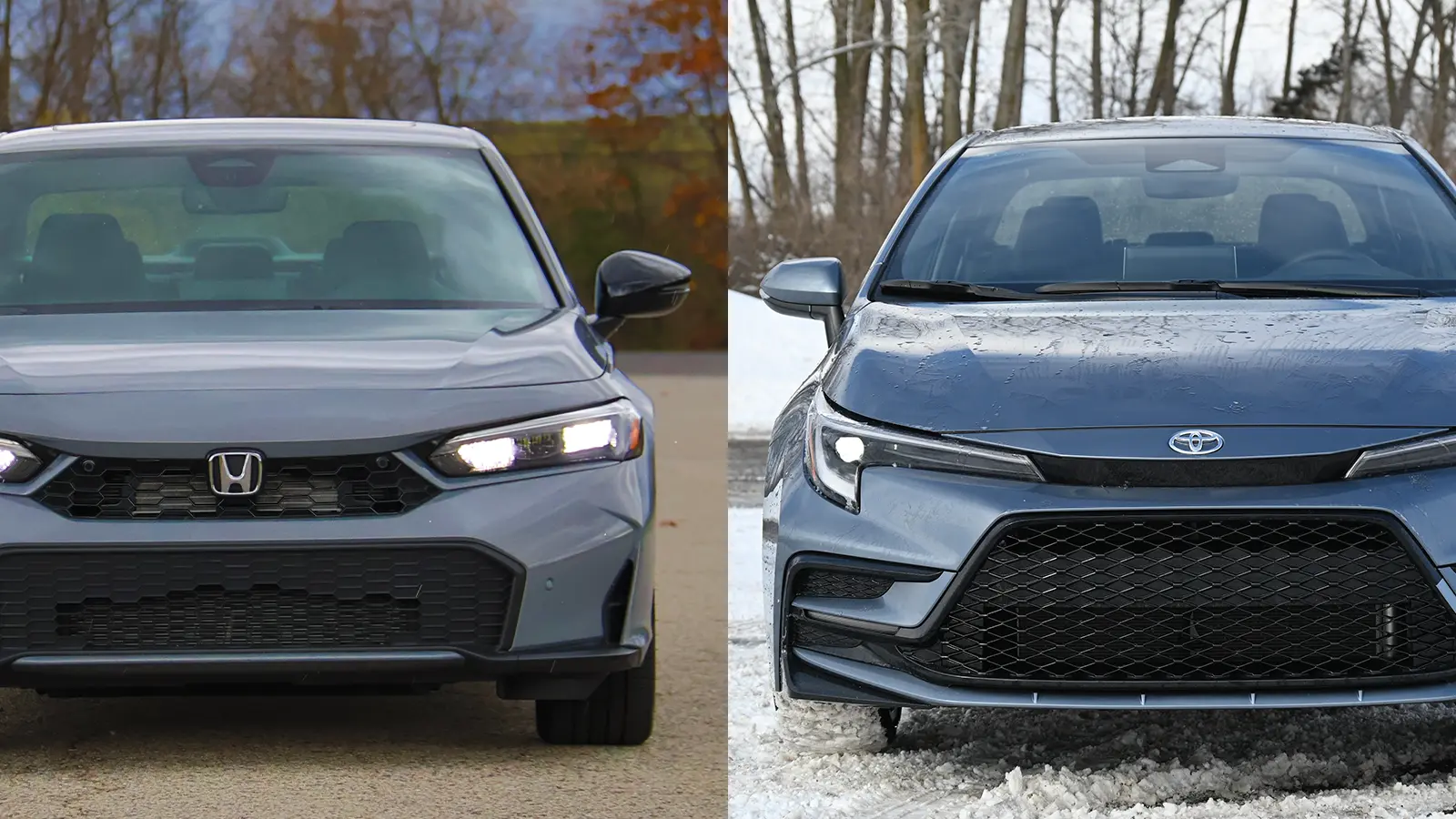

Fast Facts | 2026 Honda Civic Hybrid vs. 2026 Toyota Corolla Hybrid
⚡ Power Advantage: Civic Hybrid makes 200 hp vs. Corolla Hybrid’s 138 hp
⛽ Fuel Economy: Both deliver around an EPA-estimated 49–50 mpg combined
❄️ AWD Option: Corolla offers all-wheel drive; Civic does not
📦 Cargo Space: Civic hatchback delivers 24.5 cu-ft vs. Corolla’s 13.1
💰 Starting Price: Corolla LE Hybrid starts $4,620 less than Civic Sport Hybrid
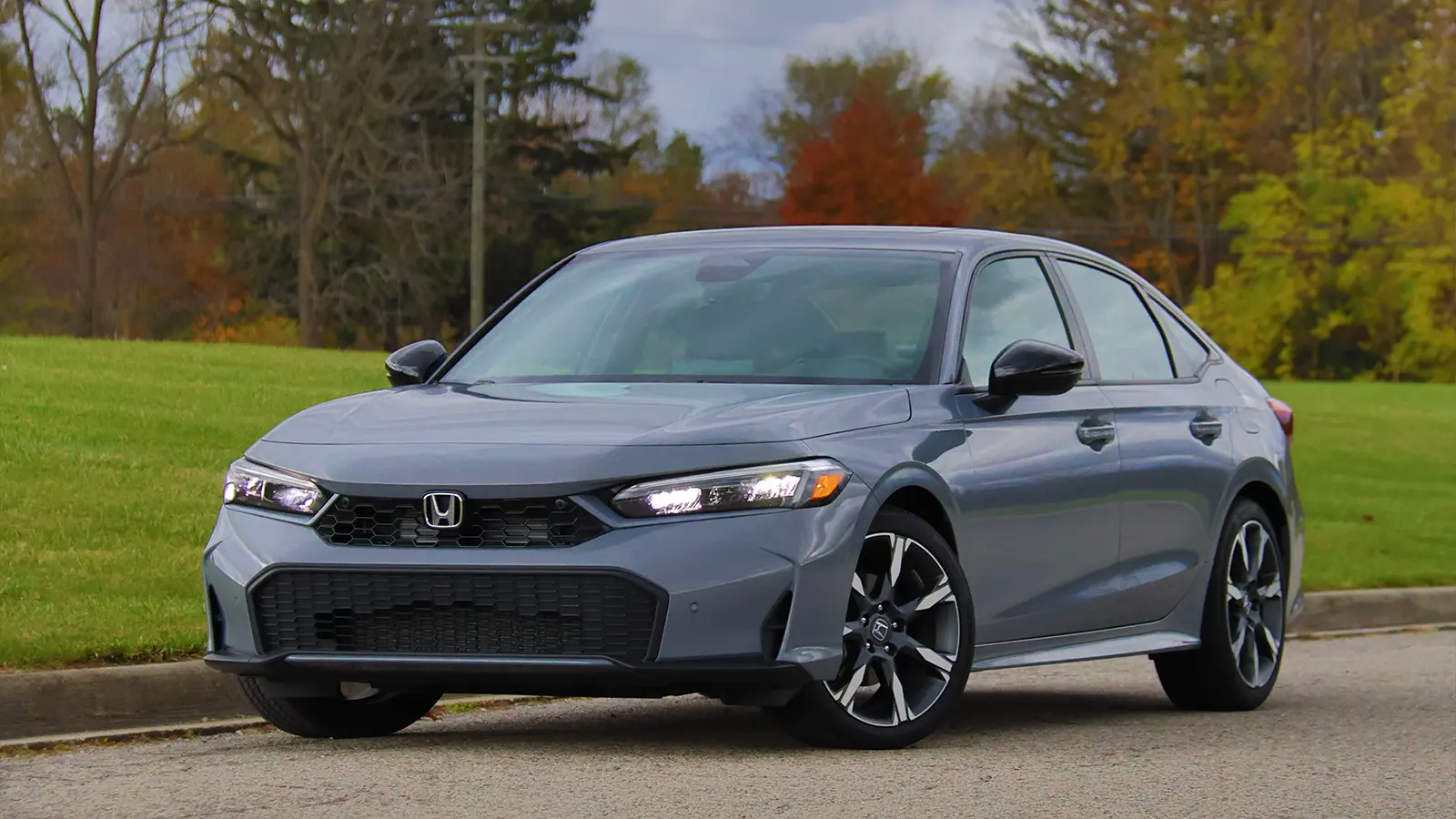
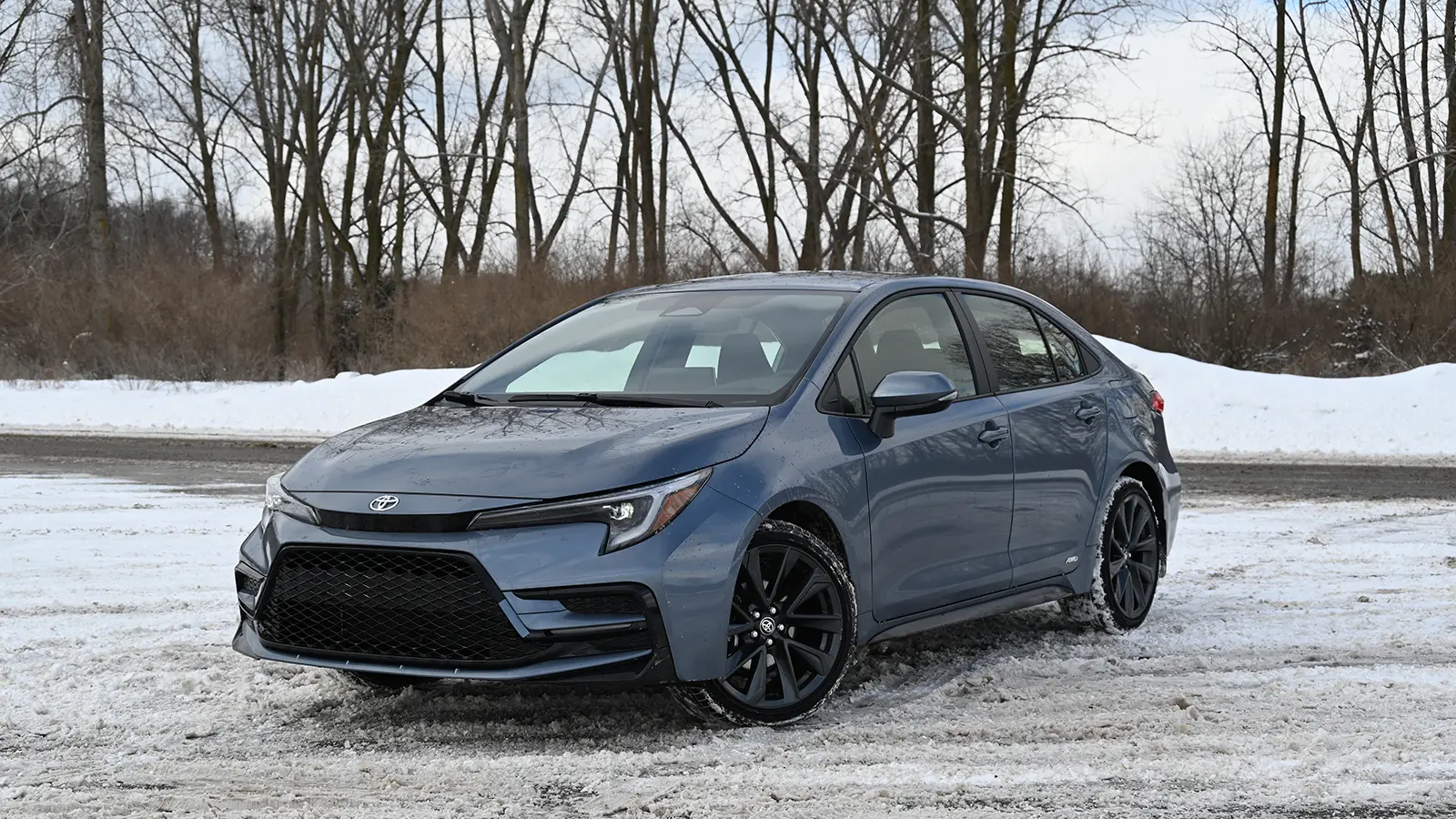
Sure, crossovers and SUVs have taken over Americans' attention, but don't count out the humble sedan just yet. Though U.S.-based automakers have mostly culled this once staple form from their lineups, two Japanese stalwarts, the Honda Civic and Toyota Corolla, are still going strong, each selling nearly a quarter-million units every year. Both are also available with excellent hybrid powertrains. I've spent time behind the wheel of both, and while they're aimed at the same buyers, they take pretty different approaches. Let's break down how these two stack up.
Exterior Design and Dimensions
The Corolla holds the crown as the bestselling car nameplate of all time, topping 50 million units since it debuted in 1966. The Civic first arrived in 1972 and has racked up nearly 30 million sales since. Both have been offered in various body styles over the years, but right now, U.S. buyers can get the Corolla hybrid only as a sedan. With the Civic, there are more options: both the sedan and hatchback come with the hybrid powertrain.
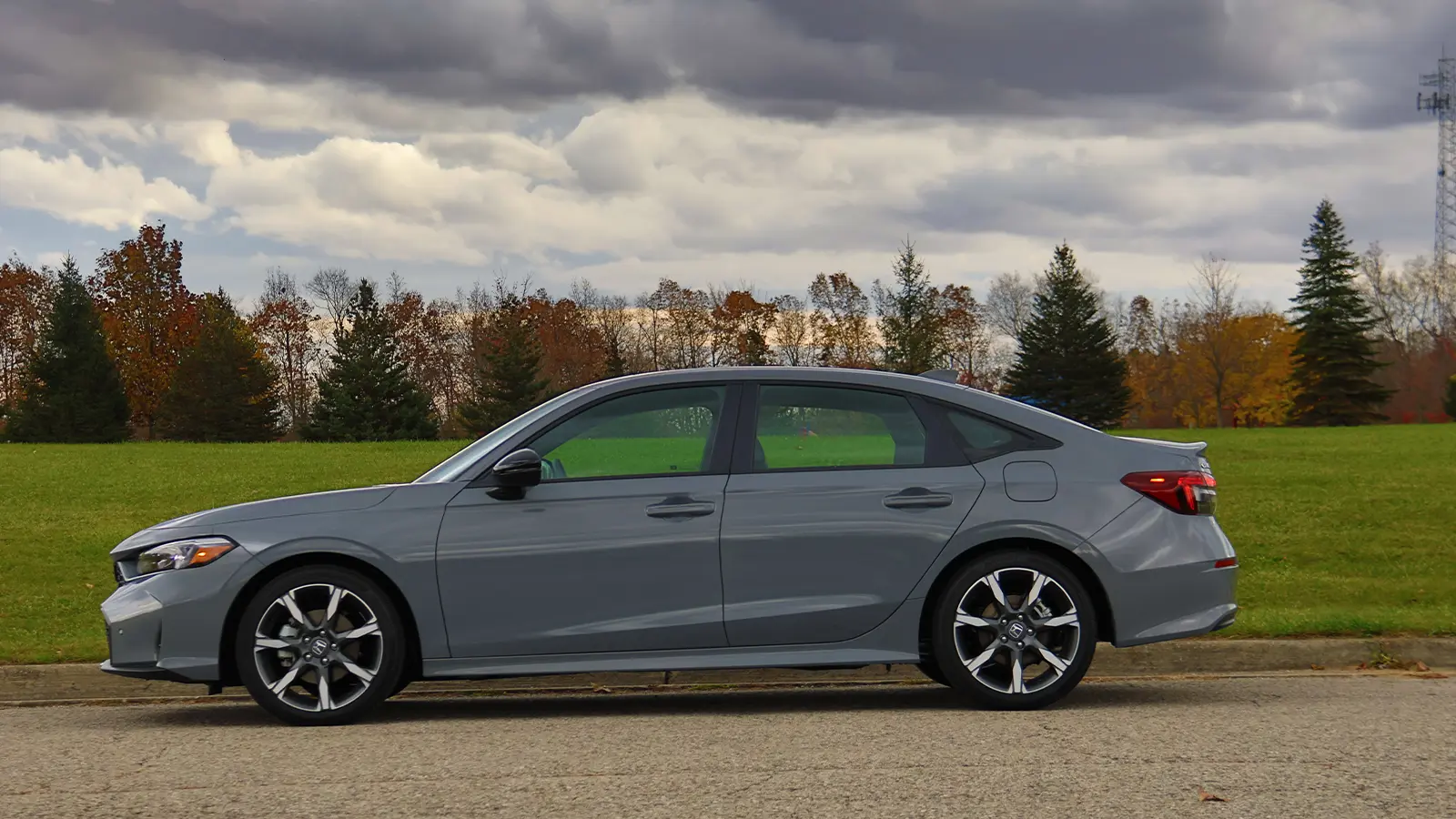
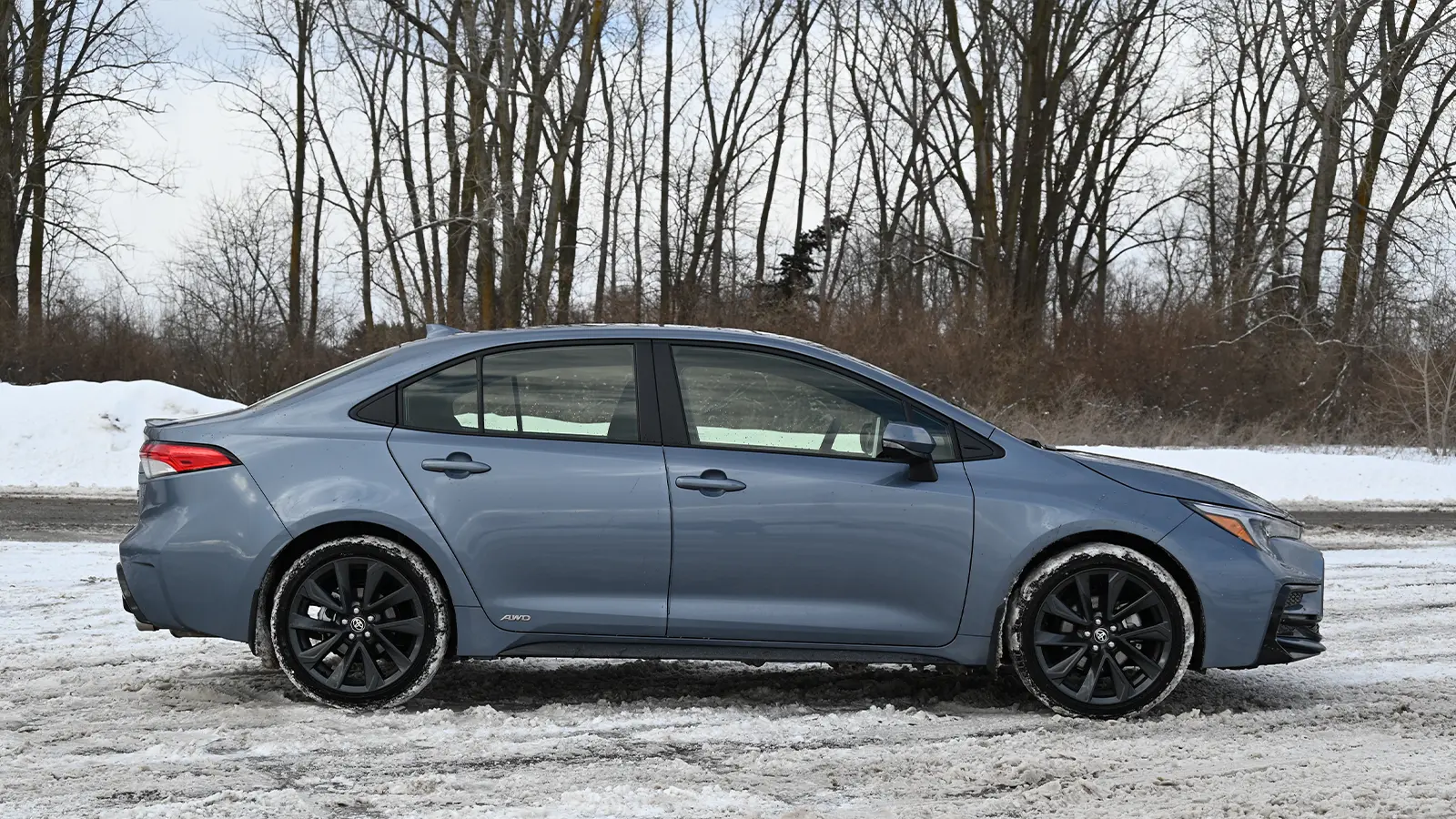
Honda's designs tend to swing between slightly wild and decidedly mild, and the current Civic (that debuted in 2021) leans toward the latter. It’s not bad, in fact, it’s quite attractive, but it’s not as eye-catching as the previous generation. The Corolla tends toward mild, too, but also has a fairly handsome design.
The Corolla is about 2.5 inches shorter and nearly an inch narrower than the Civic, though it's slightly taller. The Civic (sedan or hatch) rides on a 107.7-inch wheelbase, giving it 1.4 inches more than the Toyota.
Interior Space and Tech
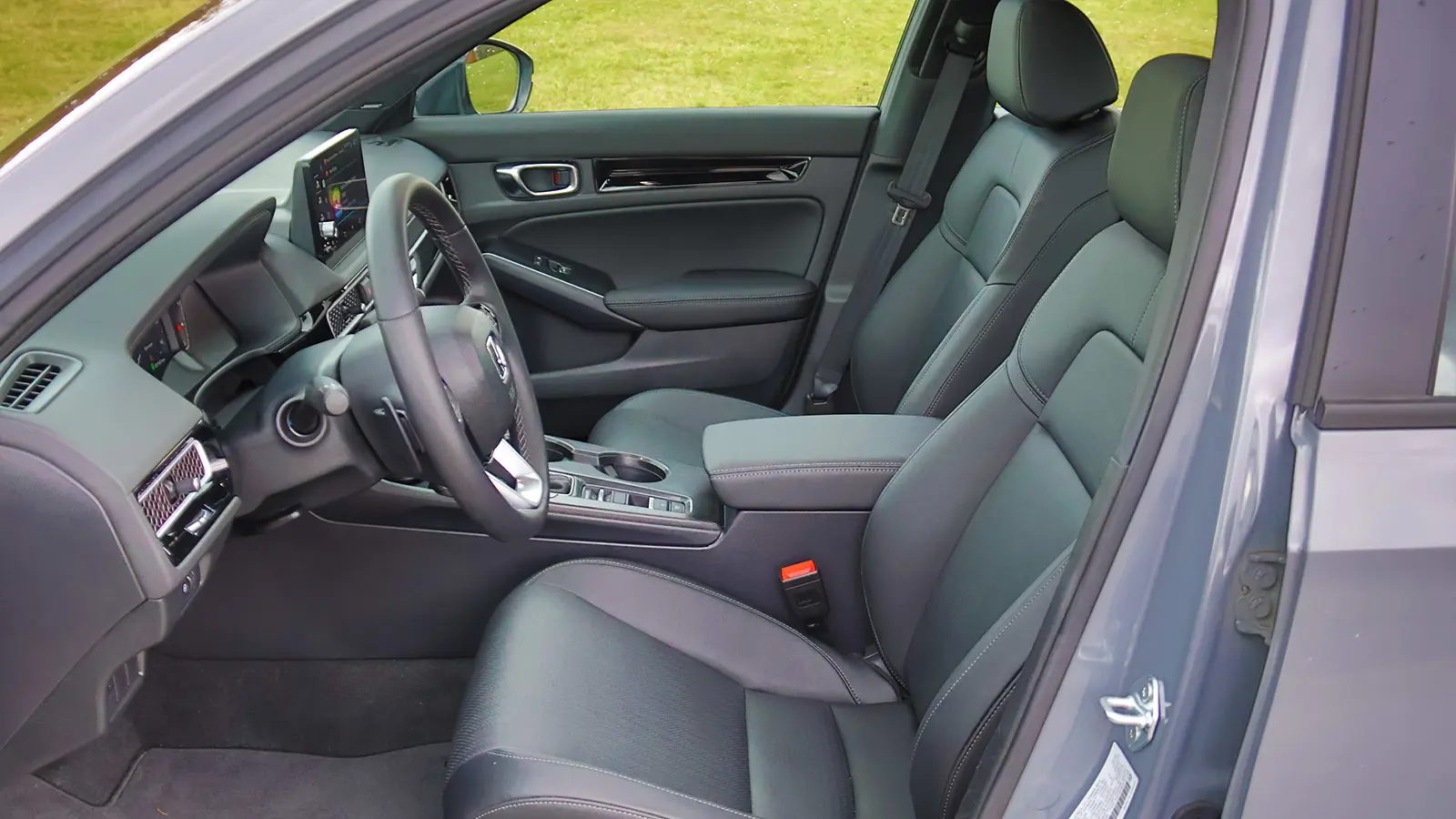
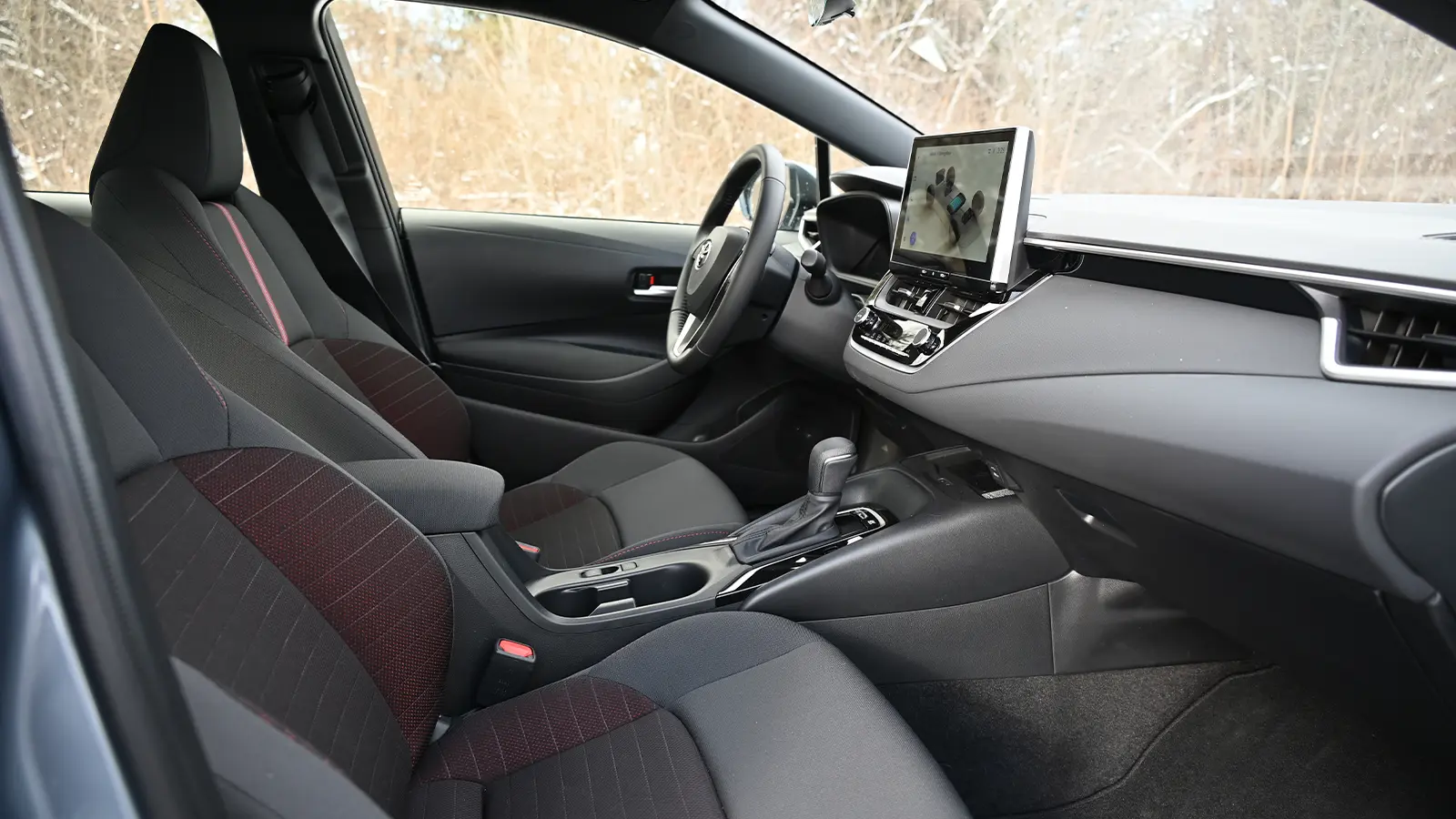
Honda's legendary packaging efficiency gives the Civic a notable advantage in interior volume over the Corolla, especially in shoulder room and legroom, though the Corolla has nearly an inch more front headroom.
Trunk space goes to the Civic at 14.8 cubic feet versus 13.1 for the Corolla. Both have split-folding rear seats for longer items. However, the Civic hatchback really shines here: 24.5 cubic feet behind the seats and a truly cavernous volume with the seats folded. Most importantly, the space is very usable thanks to the large opening of the hatchback, whereas the sedans have limited trunk opening sizes.
Both cars come with a full suite of advanced driver-assistance systems (ADAS), including adaptive cruise control, blind-spot monitoring, lane-keeping assist, automatic emergency braking, traffic-sign recognition, and automatic high beam headlights. Both have pretty similar functionality.
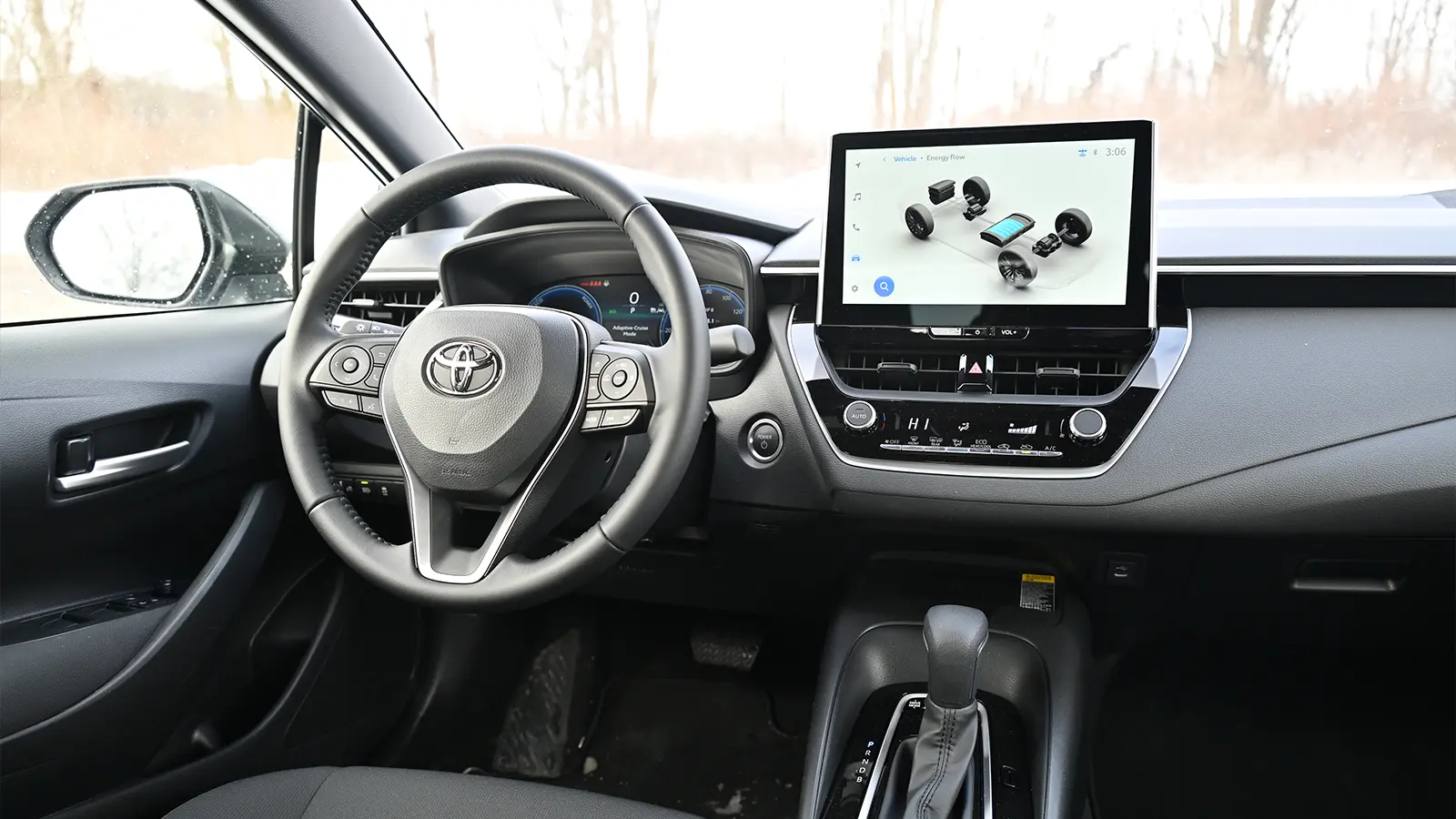
All Corollas get a standard 8-inch infotainment touchscreen with Toyota's latest Multimedia software. The SE Premium package upgrades that to a 10.5-inch screen and swaps in a 12.3-inch digital gauge cluster. It's a good system that's easy to use and responsive to commands. I’ve complained about Toyota's system not allowing a multi-pane view with media controls and navigation on the screen at the same time, but this is more of an issue on models with larger screens. With the smaller screen, it's not an issue.
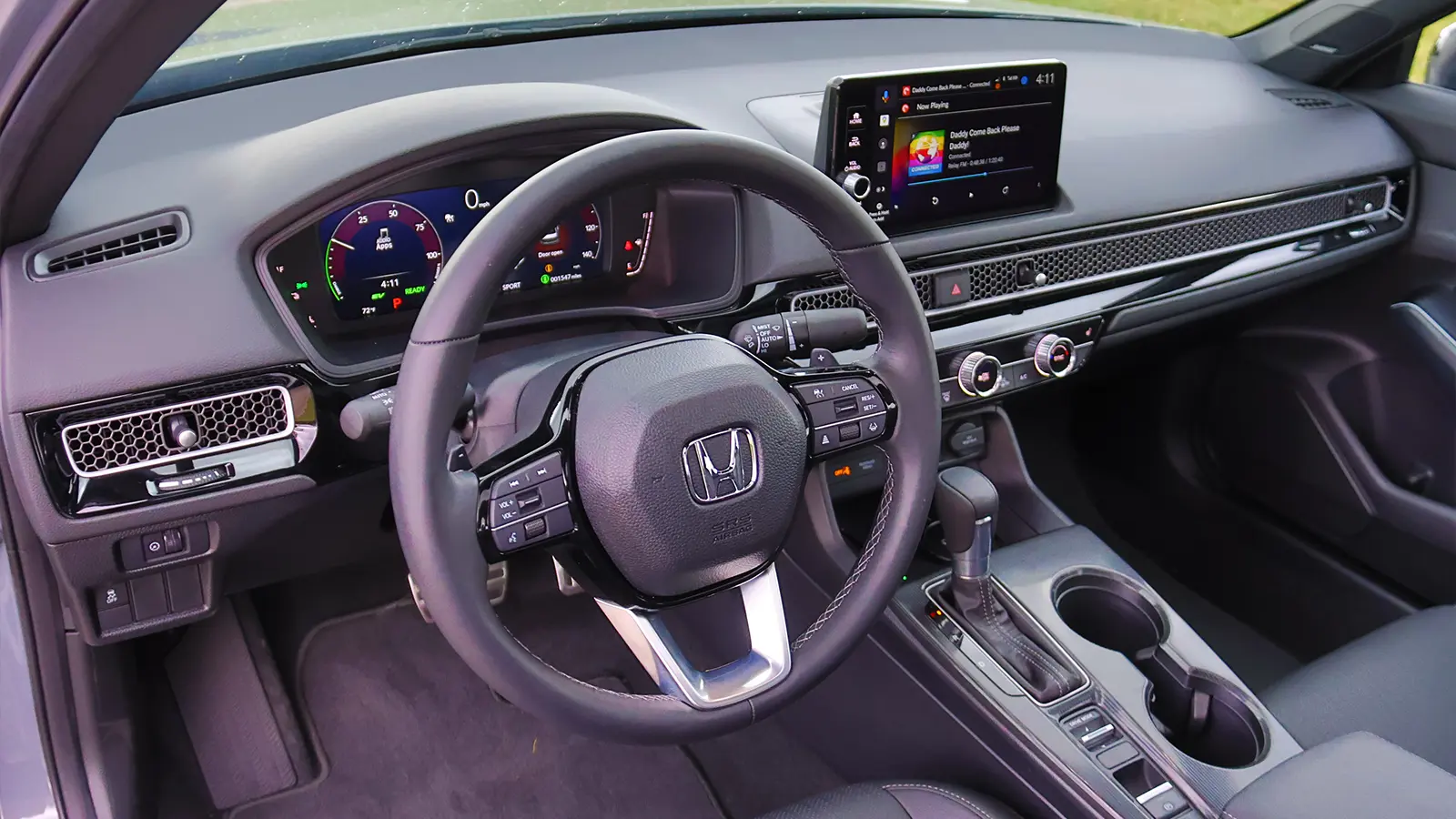
The base Civic Sport gets a 7-inch display with Honda's interface running an Android-based infotainment system. It works fine and is easy enough to use, if somewhat limited in functionality. The Sport Touring gets a larger 9-inch display and has Google built-in, including Maps, Assistant, and the Play Store for downloading apps directly to the vehicle. The system includes three years of connectivity.
Both cars support wireless Apple CarPlay and Android Auto projected from a smartphone, and wireless charging is standard on the Corolla XLE and Civic Sport Touring and available on the Corolla LE and SE.
Powertrain and Fuel Economy
Toyota has more hybrid experience than any other automaker, approaching 30 years since the original Prius launched in Japan. The Corolla uses the same powertrain found in the previous Prius: a 96-horsepower 1.8-liter four-cylinder engine paired with a 93-horsepower drive motor. You can add all-wheel drive for $1,400, which adds a 40-horsepower motor on the rear axle for better traction in bad weather. Total system output is just 138 horsepower.
Honda’s hybrid system is configured differently. It functions as a series hybrid most of the time, with a 181-horsepower drive motor doing most of the propulsion. The 141-horsepower 2.0-liter four-cylinder engine mainly drives the generator, only connecting directly to the wheels at higher speeds where it's more efficient. Total system output is 200 horsepower.
The driving experience reflects these different approaches. The Corolla's blended system with less power means you'll hear the engine rev to 4,000 rpm and stay there during acceleration. It can get pretty loud. The Civic's drivetrain is far quieter, sportier to drive, and the more powerful motor makes it feel more like an EV.
Despite the Civic weighing about 400 pounds more (3,252 pounds versus 2,850 for the Corolla), fuel economy is nearly identical. The Civic sedan hits an EPA-estimated 49 mpg combined, and the hatchback gets 48 mpg. The lighter Corolla gets an EPA-estimated 50 mpg combined for the front-drive LE and XLE and 47 mpg for the SE with larger 18-inch tires. The all-wheel-drive LE gets an EPA-estimated 48 mpg, and the SE gets 44 mpg.
Price
The base Corolla LE Hybrid starts at an MSRP of $25,970, $4,620 less than the entry-level Civic Sport Hybrid. However, the Civic comes with significantly more standard equipment, including heated front seats, a leather-wrapped steering wheel (the Corolla gets plastic), larger 18-inch wheels compared to the Corolla's 16s, a sunroof, and more. The cabin also generally feels more premium.
What Are They Like to Drive?
There’s no question: the Civic hybrids are way more fun to drive. They’re quicker off the line, more responsive at any speed, and feel far more refined thanks to Honda’s hybrid architecture, which makes less noise. The ride quality, especially on rough roads, is very comparable between the two, but the Civic handles a bit better with more precise steering and good feedback. And despite its performance advantage, the Civic doesn't give up any fuel efficiency to the Corolla.
That said, for those who live in colder climates and get more snow or rain, the Corolla's available AWD might be worth considering.
Analyst's Perspective (Which One's Right for You)
For a buyer who needs the most fuel-efficient car at the absolute lowest price, the Corolla LE is hard to beat. It'll save you about $60 a month on a typical 60-month loan compared to the Civic Sport, and it delivers stellar fuel economy.*
But if you can swing the extra cost, the Civic hybrid is the better car in almost every way. It looks, feels, and drives like the more expensive car it is. Plus, standard features like the heated seats and dual-zone climate control will close the price gap substantially when added to the Corolla. The hatchback option on the Civic is also a huge advantage for anyone who regularly carries larger items, and longer-legged passengers will also really appreciate the Civic's back seat.
*On approved credit
More Hybrid and Electrification Comparisons
2025 Honda Civic Hatchback Hybrid Excels In Fuel Economy and Utility
If cargo flexibility is a deciding factor, this shows why the hatchback changes the Civic’s practicality math
Read More ➜
Best All-Wheel Drive Hybrids
A quick shortlist of AWD-capable hybrids if winter traction is the Corolla’s biggest pull for you
Read More ➜
Best Hybrids of 2025
A broader buyer-style roundup to sanity-check whether you should stay compact or size up for the same money
Read More ➜