
Fast Facts | July 4th Road Trip Prep
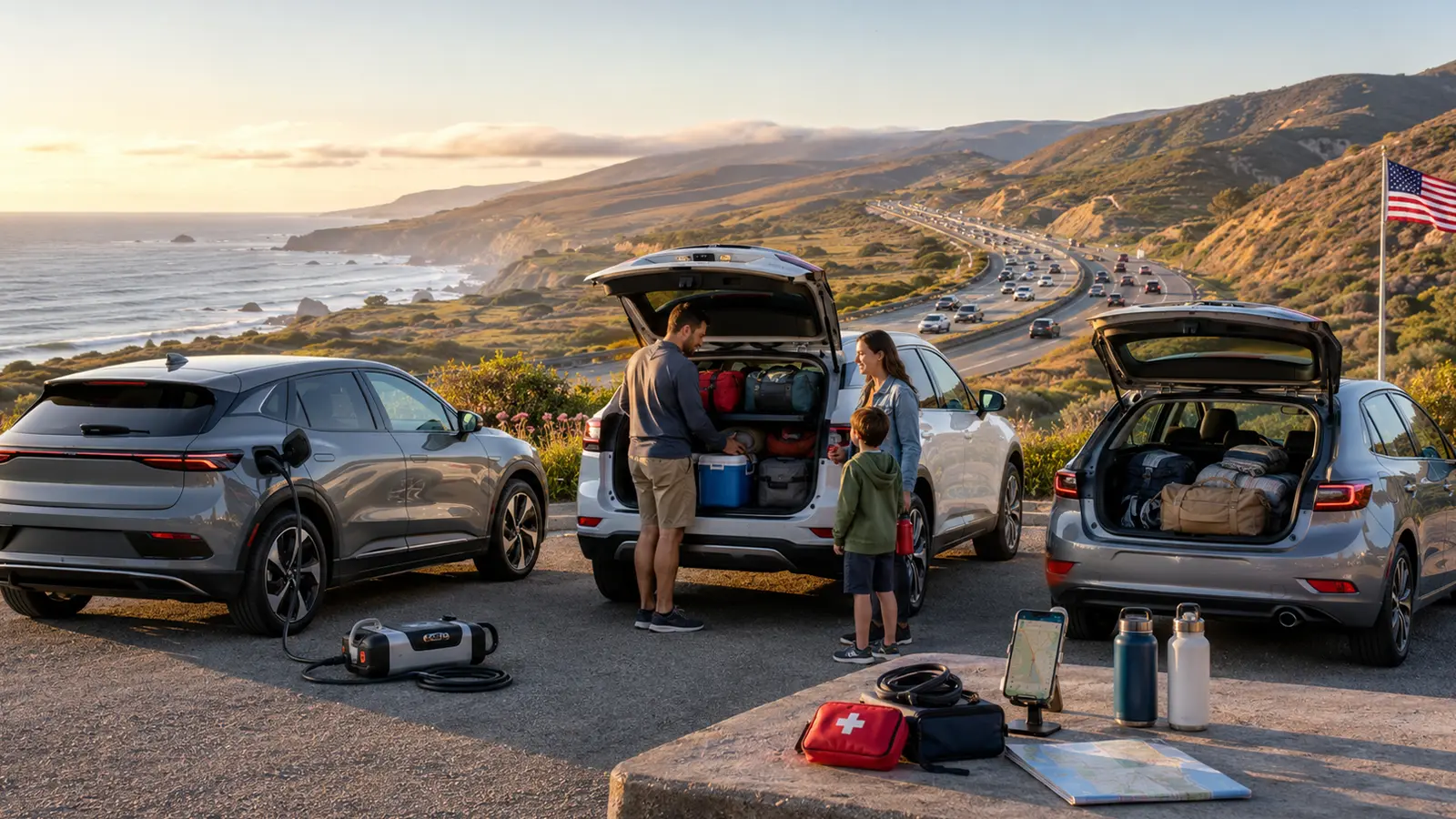
🛞 Tires: Check cold pressure, tread, sidewalls, and the spare or repair kit
🔋 EV Departure: Charge for the route ahead, with additional range when the trip requires it
📍 Route Planning: Use the vehicle’s navigation, then confirm chargers and backup locations
🔌 Charging Gear: Pack the correct adapter, portable cable, and verified network apps
⛽ PHEV Prep: Begin with a useful charge and enough fuel for the full trip
🌿 Hybrid Efficiency: Proper tire pressure, smooth acceleration, and steady highway speeds
🧰 Emergency Kit: 12V jump pack, flashlight, water, first aid, inflator, and power bank
⏰ Departure: Leave earlier than expected during a major holiday weekend
Charge, Check, Pack, Go
July 4th weekend has long marked the unofficial landmark of road-trip season in the U.S., and 2026 looks like another busy one. Whether you are driving an EV, a plug-in hybrid, or a traditional hybrid, your road trip starts with a short pre-trip checklist that pays for itself the first time you avoid a problem on the road. Here is a friendly, non-judgmental version that works for every green-car driver.
The Night Before: The Basics That Apply to Every Vehicle
Start with the items every road tripper needs, regardless of powertrain. Skip these and you are setting yourself up to find them at a gas station at 11 p.m.
- Tires. Check pressure on all four (and the spare, if you have one) against the placard on your driver's door jamb, not the number printed on the tire sidewall. Under-inflated tires cost you efficiency and run hotter on long drives. While you are there, look at tread depth and any sidewall damage.
- Fluids. Even on EVs, check coolant level and windshield washer fluid. On hybrids and gas vehicles, also check engine oil and brake fluid. Topping off the washer reservoir is the cheapest insurance against a smear-streaked highway windshield.
- Wipers. Replace them now if they squeak or streak. Summer afternoon storms appear quickly.
- Lights. Walk around the vehicle with someone tapping the brake pedal and signals. Five minutes; can prevent a traffic stop.
- Emergency kit. First aid, jumper cables (or a portable jump pack for EVs, which still use a 12V auxiliary battery), a flashlight, water bottles, and a phone charger that does not depend on the car's infotainment system.
If You Are Driving An EV: Charging Strategy
This is where EV road trip prep adds a few specific steps. None of them is hard; all of them get easier with experience.
Plan The Route, Then Plan the Stops
Use your car's built-in route planner first; modern EV navigation is usually well-tuned to your specific vehicle's range and charging curve. Cross-check with at least one app like A Better Routeplanner (ABRP), PlugShare, or Chargeway. Differences between the apps can flag a station that is unreliable, frequently full, or temporarily offline.
For a typical Memorial Day weekend trip:
- Aim to charge from about 10 to 20 percent up to 70 or 80 percent at each stop. Charging slows considerably above 80 percent on most EVs, so stopping at 80 and driving on usually saves time overall.
- Identify a backup station within 10 to 20 miles of each planned stop. Holiday weekends are when popular Supercharger sites and busy Electrify America stations are most likely to be crowded. Our companion piece on what to do when public chargers are unavailable goes deeper on backup strategies.
- Pre-condition the battery before fast-charging stops if your vehicle supports it. Most modern EVs do this automatically when you route to a charger; a warmed pack accepts power faster, especially on cooler May mornings.
If your preferred charging stop is full, offline, or farther away than expected, our guide to what to do when EV charging feels scarce offers practical backup strategies for getting the trip moving again ➜
Pack The Charging Gear You Might Actually Need
- Your portable Level 1 cable, in case you end up at a destination with a regular 120V outlet and no faster option.
- Your NACS-to-CCS adapter (or CCS-to-NACS adapter, depending on the car), if your vehicle uses one to access the Tesla Supercharger network.
- A printed list of the charging-network apps you might need, with login credentials accessible somewhere other than just the vehicle's screen. Useful if your phone is dead and you are at a station.
Before leaving, use the GreenCars charging-station finder to identify compatible stations, available ports, charging speeds, and possible backup stops along the route ➜
If You Are Driving a Plug-In Hybrid
PHEVs make holiday weekends easy: full electric range for the in-town parts of the trip, gas tank for the highway. A couple of small notes:
- Start the trip with a full electric charge and a full tank of gas if you can. Both are usually cheapest at home and at familiar local gas stations, respectively.
- If your destination has a 120V outlet you can park near (a relative's house, a vacation rental), plug in overnight. You will start each day of the trip with a fresh electric range.
- Be honest about hold mode. Most PHEVs let you choose to hold battery charge for later in the trip, useful if your destination has stop-and-go traffic where electric drive really shines. Used thoughtfully, it can stretch overall efficiency.
If You Are Driving a Hybrid
Hybrids on a road trip behave like fuel-efficient gas cars at highway speeds (most of the regenerative-braking efficiency advantage shows up in stop-and-go driving, not on the interstate). Two notes to maximize efficiency:
- Keep tires properly inflated. Probably the most controllable variable for highway efficiency on any vehicle, hybrid included.
- Use cruise control on long flat stretches. Smooth speed maintenance is consistently more efficient than constant small accelerator inputs.
Packing For Comfort, Not Just Survival
A few small things that tend to make a long drive nicer regardless of what you are driving:
- Sunshades for back-seat windows if you have kids or are driving west into a setting sun.
- A cooler with snacks and drinks. Highway food is fine; highway food at every stop gets expensive and tiring.
- A small trash bag clipped to the back of the front seat. Worth its weight in not having to clean out fast-food wrappers later.
- A downloaded playlist or audiobook, in case cellular coverage drops in rural areas. Streaming-only music libraries are not your friend in the mountains.
- For families: one new small toy or activity per child, sealed and not introduced until you have been on the road for an hour. The peace-of-mind value is immense.
The Night Before: A 10-Minute Final Pass
If you can only do one thing the night before you leave, do this:
- Charge or fuel the vehicle to full.
- Confirm your route and first charging or fuel stop.
- Check tire pressures.
- Pack the emergency kit and any charging adapters.
- Set the alarm 15 minutes earlier than you think you need. Holiday-weekend traffic punishes the optimistic departure time more than almost any other variable.
Long weekend road trips have been a tradition for a long time, and they work just as well in a green car as they ever did in a gas one. A short pre-trip checklist (tires, fluids, charging or fuel plan, packing) tends to be the difference between a smooth drive and an annoying one. Whatever you are driving, take 30 minutes the night before, leave a little earlier than you think you need to, and have a great weekend.
More Road Trip Tips for Green-Car Drivers
How to Plan the Perfect EV Road Trip
Build a realistic route around range, charging speed, station locations, weather, elevation, and the stops you already want to make.
Plug-In Hybrid Best Practices
Learn how charging habits, drive modes, preconditioning, and trip planning can help you get more electric driving from a PHEV.
Hybrid Driving Tips
Use smoother acceleration, regenerative braking, proper tire pressure, and the right drive modes to improve hybrid efficiency on the road.