

Fast Facts | 2026 Toyota Camry Review
🔋 Powertrain: Two-motor hybrid system with 2.5-liter four-cylinder
⚡ Output: 232 horsepower total system output
⛽ Fuel Economy: EPA-estimated 50 mpg combined (Hybrid All-Wheel Drive LE)
🖥️ Infotainment: 8-inch touchscreen standard, 12.3-inch touchscreen available
🚗 Drive Feel: EV-like operation at low and moderate speeds
💰 Price Range: $31,820 to $38,220 MSRP including delivery and all-wheel drive
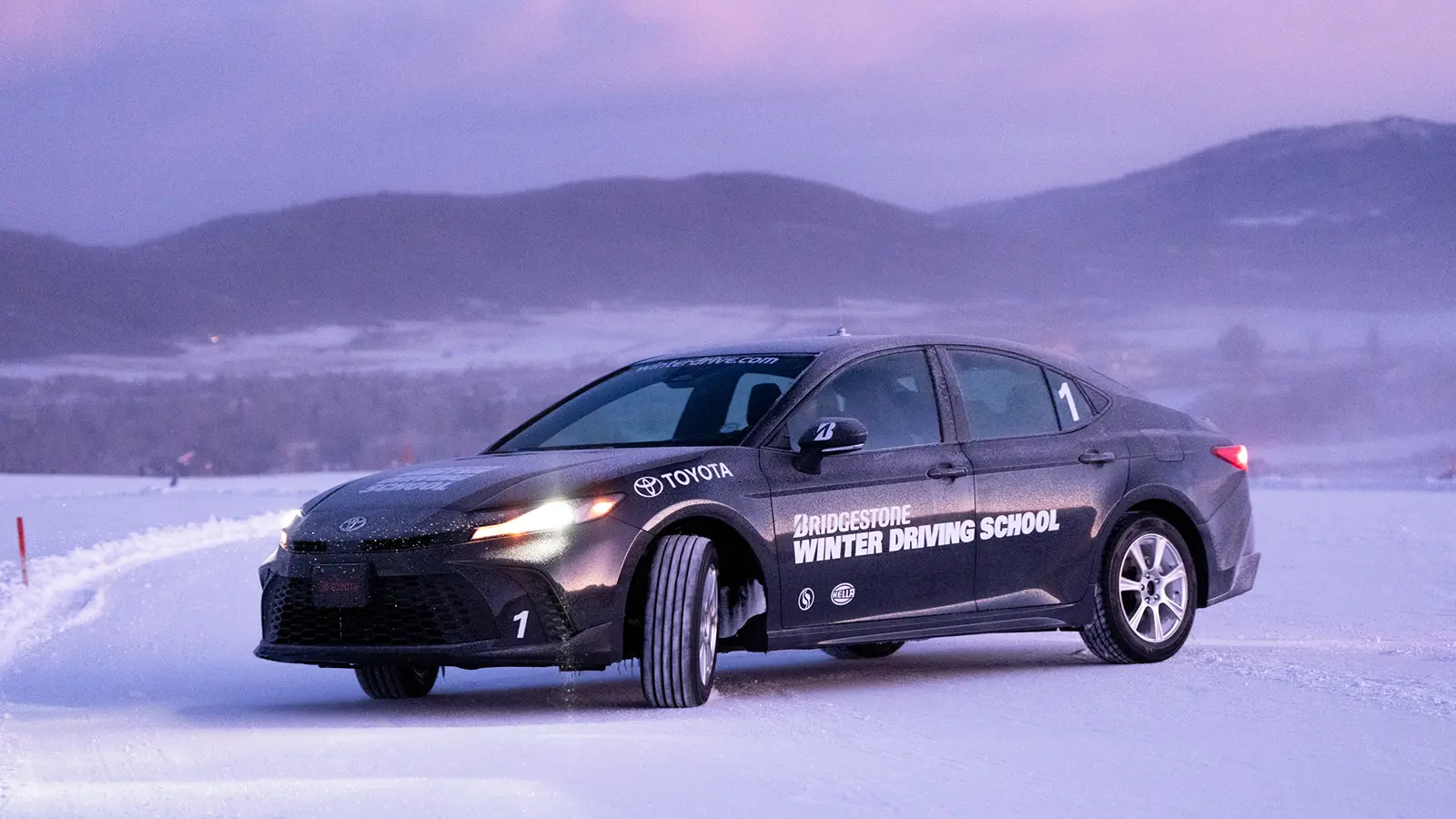
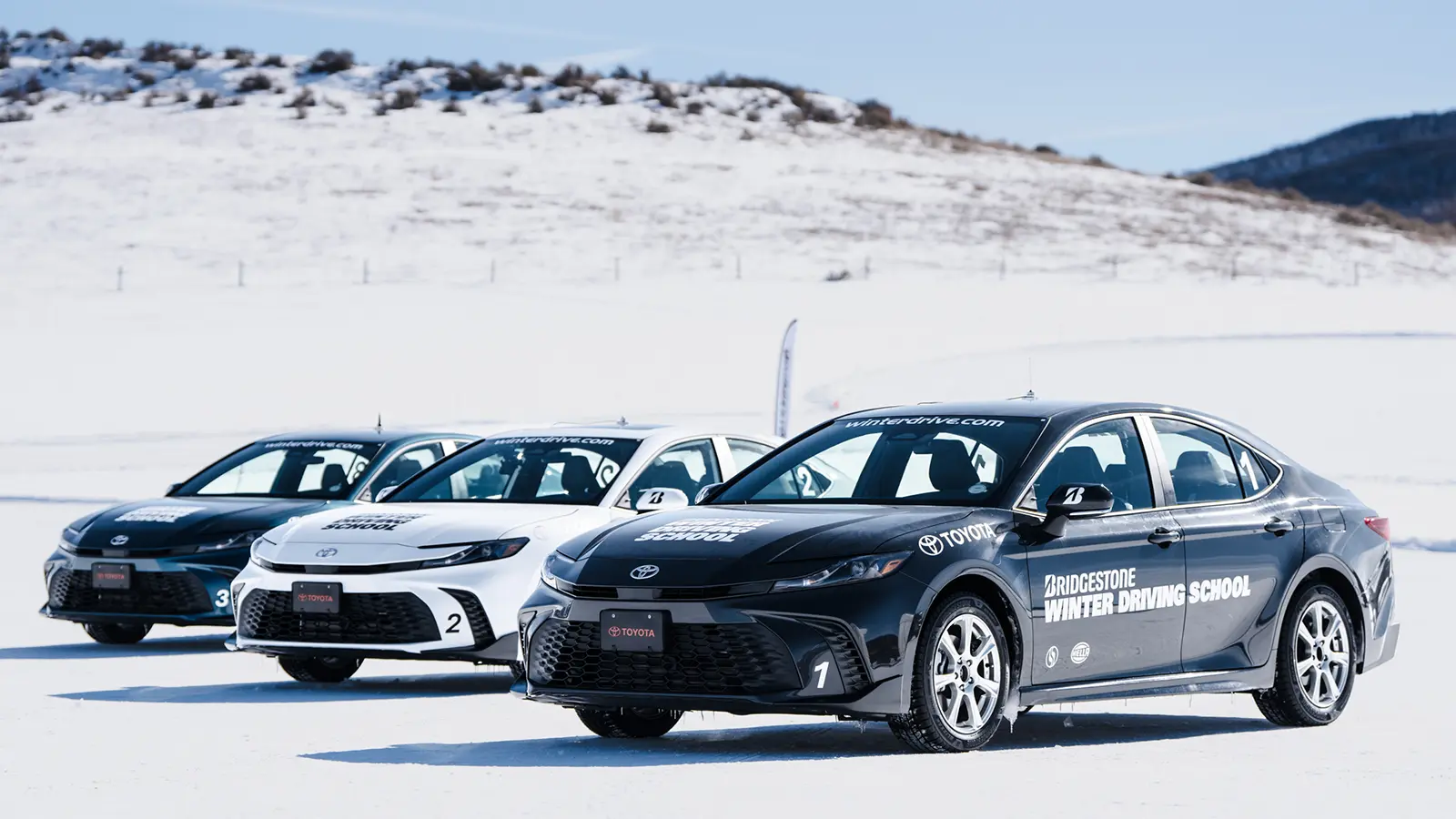
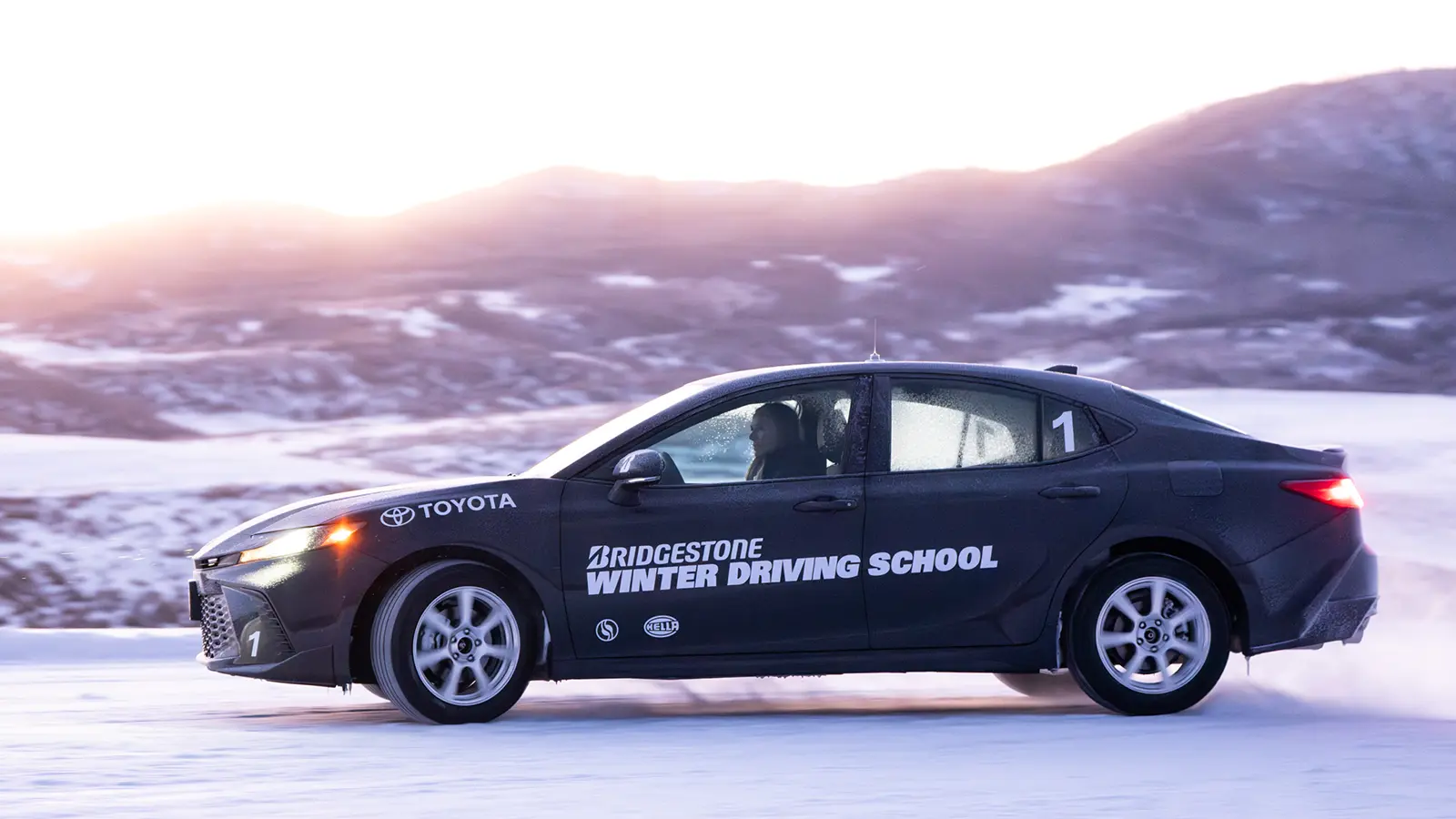
I am decidedly a California gal. I live in the desert and rarely have to drive in rain, let alone snow or ice. So, it was with nervous excitement that I attended the Bridgestone Winter Driving School in Steamboat Springs, Colorado, to learn car control on the slick stuff. My steed for the day: 2026 Toyota Camry with all-wheel drive shod in the new Bridgestone Blizzak IcePeak tires.
Why Winter Tires?
Considering that tires are the only part of your vehicle that actually touches the pavement, it behooves drivers to spend a little money here and choose the right tires for the environment. You might be tempted by running all-season tires and nothing else, and that might be fine for much of the country. However, if your winters are regularly below 45 degrees, even if you don’t get much snow, winter tires offer more grip and performance than all-season tires ever could.
First off, winter tires are made of a softer compound, which helps maintain grip on cold pavement. A summer or even all-season tire will harden up as temperatures start to drop, and a hard tire can’t withstand the physics of a cornering car. Further, winter tires have a tread pattern that packs in the snow. Since snow grips better to snow than it does to rubber, you’re less likely to lose traction and go sliding into a stopped car or street sign. So don’t panic if your tires look a bit like a snowball - it’s actually a good thing.
Oh, and if you’ve got your Bridgestone IcePeaks on for the season and the sun decides to come up, you can safely run your winter tires when it’s warm. You’ll actually get more grip as the softer compound works well with the heat. However, they will wear quicker, so it’s best to swap them out when the temperature starts climbing.
Slip Slidin’ Away
Having learned all this, it was finally time for me to get into the snow. My all-wheel drive Camry was also a hybrid - as all Camrys are - rated for a healthy 232 horsepower. Toyota achieves that number with a 2.5-liter four-cylinder gas engine and two electric motors. Keep in mind that the rear motor only puts 40 horsepower to those rear wheels, so while it’s true that both the front and the rear wheels get power, the Camry is very much front-wheel-drive-biased.
On the snow, that translated to plenty of understeer. You’ve likely felt this when you steer hard in one direction, but the car just keeps going straight. The IcePeak tires definitely help, but understeer is just a fact of life in slippery conditions, no matter what the tire, especially if you’re a beginner like me. The question isn’t will you understeer, it’s how much.
If you want to compare trims, prices, and competitors fast, the GreenCars Buyer’s Guide tool is the quickest next step ➜
You can prevent understeer by making your inputs slow and smooth and by braking to get the weight to transfer over the front tires, inducing grip. If you find yourself in the middle of an understeer event, don’t panic and hit the brakes harder. Gently lift, unwind your steering wheel just a bit, and let the tires find traction. Once I learned the technique, the IcePeak rubber found grip every time, and I could complete my turn easily. However, it would have been easier in a vehicle that had a bit more power going to the rear wheels. A car that splits power evenly to the front and rear will be much more balanced and easier to drive.
Braking to a stop in a straight line was a little scary at first. The last thing I wanted to do was slam on the brakes, as it seemed so counterintuitive. But the Camry’s ABS system and the IcePeak’s tread did their job, and the car stopped without any drama. In fact, the IcePeak tire is the first Bridgestone tire to earn the 3-Peak Mountain Snowflake certification, which signifies it accelerates better on snow, and the Ice Grip certification, signifying superior stopping on ice.
The Camry’s hybrid and all-wheel drive system performed the best on a maneuver meant to mimic a quick lane change. I approached it at 30 miles per hour, flicked the steering wheel left and back to the right again to avoid hitting a cone, and the car stayed true. Hey, maybe I’m not too bad at this whole ice driving thing.
The Camry is Good - To a Point
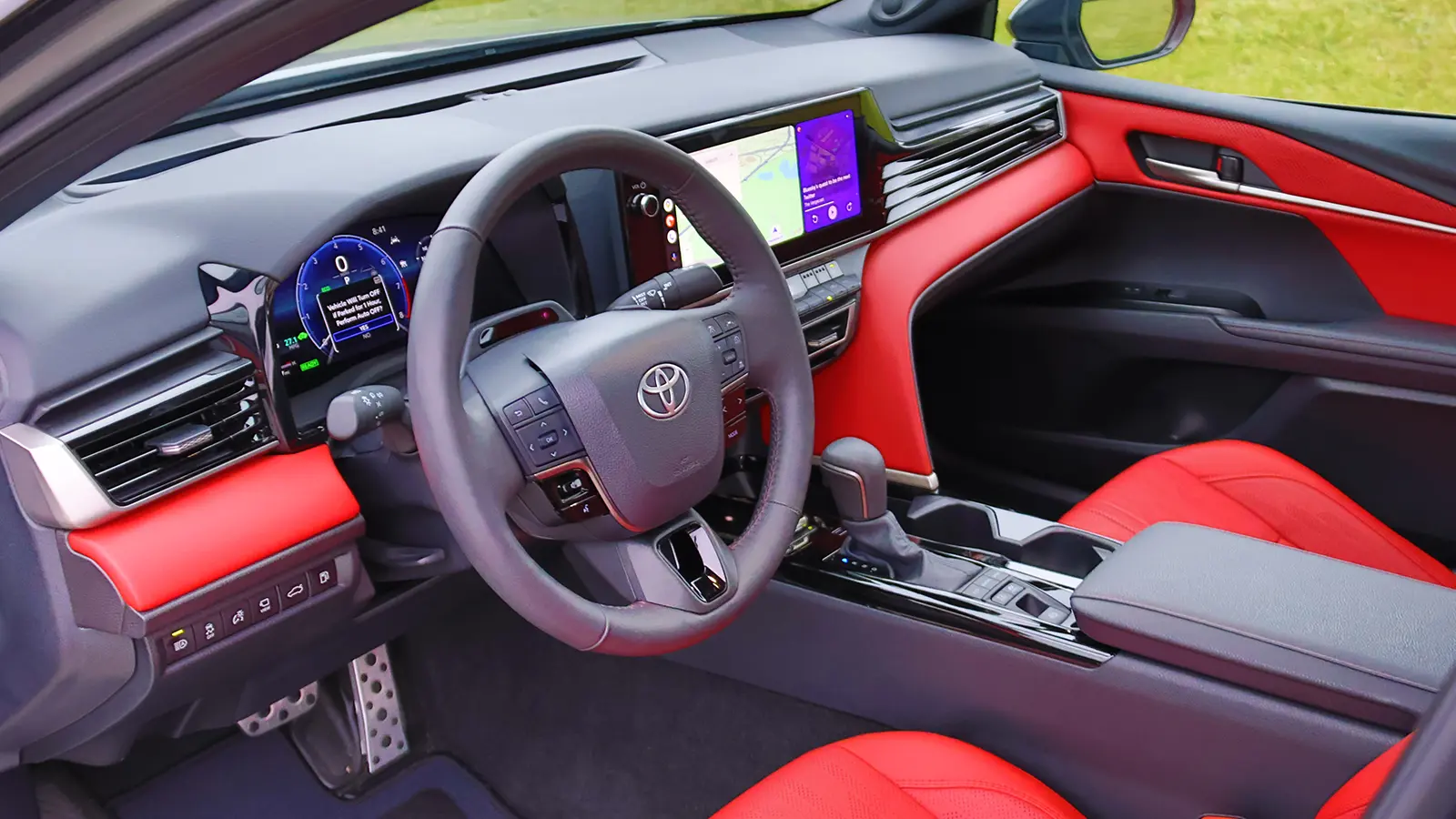
Even though the 2026 Toyota Camry Hybrid with all-wheel drive returns an EPA-estimated 50 miles per gallon combined, I’m not sure it would be my first choice if I lived somewhere with heavy snow every winter. It performed fine on packed snow of the Bridgestone course with the IcePeak tires, but at the end of the day, it’s a low-slung sedan. You won’t be making fresh tracks right after Mother Nature dumps eight inches of the white stuff.
I’d rather look to a crossover like the hybrid versions of the Subaru Crosstrek or Forester. The all-wheel drive system here puts more power to the rear wheels for a more balanced drive, and the higher ground clearance means I wouldn’t have to wait for the plows to clear my street. For those who really want to snow wheel in the forest, a Jeep Wrangler, Ford Bronco, or Toyota Tacoma will do you nicely. Of course, none of these can deliver the stellar fuel economy of the Camry, but you’ll likely get a tad further in blizzard conditions.
If you’re considering a hybrid sedan with serious power and comfort (different price tier, same “hybrid still feels premium” intent), the 2025 Mercedes S63 Hybrid review is a sharp cross-shop contrast ➜
However, Toyota makes it pretty easy to outfit your Camry for cold weather. All-wheel drive is available on every trim for an extra $1,525, and every trim gets heated outside mirrors. Heated front seats and steering wheel are standard on the top XLE and XSE trims, while you’ll need to purchase the Cold Weather package on the LE, SE, and Nightshade trims. On the LE, it’s $610, and you’ll need to add the $1,050 Convenience package, while the SE and Nightshade trims charge $500 for the Cold Weather package and $600 for the required Convenience package.
You can snag a bare bones hybrid Camry with all-wheel drive for an MSRP as little as $31,820, which puts it in the middle of Toyota’s all-wheel drive hybrid car lineup. Other offerings are the all-wheel drive hybrid Corolla, Prius, and Crown. And if you want to learn a bit about snow driving, Bridgestone’s classes start at $390 for the basics, all the way up to $3,825 for a two-day speed fest in the Toyota GR Supra, GR86, and GR Corolla. You can even bring your own car for one-on-one instruction if that’s your thing.
Trust me. You’ll have a blast.
🔋 More Hybrid Buying Intel
The Honda Accord Hybrid Deserves Your Attention
A quick, buyer-friendly look at why the Accord Hybrid remains one of the smartest sedan plays in the segment
Read More ➜
Best Hybrids of 2025
A curated list of the top hybrids this year, great for cross-shopping beyond the Camry bubble
Read More ➜
Best Used Hybrid Cars to Buy in 2025
If new pricing is a stretch, this guide helps shoppers find strong hybrid value on the used market
Read More ➜